Wednesday, October 31, 2012 Categorized under Basic

Expansion of Self, Consciousness, and Lucidity While Awake or Asleep

Expansion of Self, Consciousness, and Lucidity While Awake or Asleep

by
Beverly (Kedzierski Heart) D’Urso, Ph.D.   Copyright  © 2012

http://www.durso.org/beverly/

http://wedreamnow.info/

Presentation for the Science and Non-duality Conference: “The Nature of the Self,” San Rafael, CA, October 2012

Spiritual teachers talk about “Being in the Present Moment.” For me, this appropriately describes the point of becoming lucid in a dream. I believe that lucid dreaming can help even non-dreamers better understand self-realization.

I see lucidity in the sleeping state as a microcosm of self-realization in the waking state, which I study in my spiritual work. At this point, I follow the Diamond Approach path of A. H. Almaas as a member of the Ridhwan School and Seminary. Almaas, namely Hameed, spoke here last night as an invited keynote address.

Today, I will show how lucidity actually relates to what I call expansion of self, and what it means to have levels of lucidity when asleep or awake.

Beverly and Stephen

I did not know the term lucid dreaming until the late 1970’s, when I had the opportunity to do lucid dream research with Dr. Stephen Laberge at Stanford University before and after completing my MS degree that focused on Cognitive Psychology and my PhD that involved Artificial Intelligence.

Just before this, I discovered that I my dreams since the age of seven get called lucid dreams. In one memorable one, I faced my fears of the scary witches from my recurring childhood nightmares.

One night, I looked the scary witches in the eye and simply said, “Okay, what do you want? Let’s get this over with! I have used this experience to enhance my dreams and my life in numerous ways ever since.

Lucid dreaming simply means that I know I dream while I dream. It does not necessarily imply control of the dream as popular media often suggests, although it does involve more than merely having clarity or awareness.

Dream World Picture

I define the term dream as an experience of an outer world made up of characters, actions, and an environment that an expanded self has helped create. I define the term expanded self as a collective mind, and not merely the brain in the head asleep on a pillow.

The waking state fits my definition of a dream, hence my work gets called Lucid Dreaming/Lucid Living. I say that Beverly sleeps while her dream self plays and Beverly plays while an expanded self sleeps. In other words, I say I dream in any moment where a ‘me’ exists to have an experience.

With lucidity, I see myself as more than just my body, I view anything as possible, and I see everyone and everything as parts of an expanded self.

Beverly’s   website

I started giving presentations on lucidity in 1986 for the annual International Association of the Study of Dreaming conferences, both in-person and, in the last decade, online as well. You can find most of my seventy publications on one of my websites, for example: www.wedreamnow.info. You might wonder why I gave the site the name wedreamnow.

The current state I find myself in serves as the most important one for me, and I tend to say that we dream now in every moment. However, I don’t say we, in this room, exist in my dream, but in our dream, which comes from the collective mind I described earlier.

By a show of hands, how many people here feel we might exist in a dream right now?

CHART THREE LEVELS

I will refer to a chart called Levels of Self or Consciousness where I show how my sense of self expands or contracts. This does not necessarily occur, however, in a linear fashion, which I will show for sake of simplicity.

I feel that only one reality exists, and my experience depends upon my level of lucidity. I do, however, discuss two states, namely the waking state and the sleeping dream state. I use this time-related distinction because people typically say they dreamed in the past or will dream in the future.

Therefore, I have divided the chart into columns for the WAKING STATE and the SLEEPING STATE. It describes three major levels: non-lucidity, lucidity, and beyond lucidity. The actions at each level occur in, or relate to, one of the two major states.

At different times in my life, I may have dreams that I can’t even recall, while in my waking state I seem very lucid. The opposite can occur as well. Also, I can lose and gain lucidity in a single moment.  At each level, different methods can encourage such expansion. Only a few will get discussed in this rather short presentation.

CHART OF Witch Dialog

In developing my chart, I will give some examples of issues with my spouse and my witches. I summarize how my levels expanded as a child and beyond in the following way.

I feel scared.

The witches scared me last night

I see witches, so maybe I am dreaming.

Take me in tomorrow night’s dream

Witches, what do you want?

Witches, come help me

Thanks for serving as my creative power, witches!

Note that I discovered much later in life that the witch dream scenario almost perfectly matched a terrible accident I had at eighteen months old when I broke my collar-bone.
CHART EACH LEVEL

I label the first two levels non-lucidity because at these levels, I don’t have much awareness in the moment. I call the first one the contracted level. At this level, I do not reflect (11) upon what I do. When I act at this level in either state, I may blame, suffer, laugh, or just simply not pay attention.

In the sleeping state, I may have what we typically call dreams, but I do not recall them, let alone recognize them in the moment.

In either state, when I notice after the fact that I have acted, for example, in hurtful ways, I call this the level of reflection. I have not expanded enough to notice or change my actions in the moment, but I can recall life issues, or dreams from my past, and learn from them.

At this level, I remember sleep state dreams only after they happen, and therefore they get called non-lucid dreams.
For example, to reduce my tendency to always blame others in the waking state, I may seek therapy.  To learn from my dreams, I may join a dream group. At this reflection level, I likely feel limited, and I view my world as unchangeable.

At this level in the waking state, I might yell at my spouse and blame him for my hurt feelings. In the sleeping state, I might try to run away from scary witches that chase me.

After the fact, I might try to figure out ways in which I can deal with my feelings concerning my spouse or the witches the next time I face them.  Before I went to sleep as a child, I did, in fact, begin to think about how the witches only came in dreams.
The next levels I label lucidity. Whether in the waking state or the sleeping state, when I really pay attention to my environment and my body, and I inquiry into my assumptions, my level expands.

The first level of lucidity I call semi-lucid. At this level, in the previous examples, I might notice in the moment that the source of my hurtful experience does not come from my spouse. In the case of the witches, I might question if I am dreaming.

The mere act of inquiring brings me to this semi-lucid level, even if I do not know for certain that I dream in the moment. As a young child, I remember asking the witches to “Spare me tonight, and take me in tomorrow night’s dreams.”
The next level I call lucid. I often experience expanded potential and more awareness. In the waking state, with even partial lucidity, I find that small frustrations disappear quickly, and I experience more presence. I focus on the present moment, and feelings of ambition or regret don’t come up. Time tends to disappear. I see my life as a dream.

When I know I dream while I dream in the sleep state, my fear decreases and my mind clears. I do not have to ‘do’ anything, but merely realize that I dream while I dream.

If I question my assumptions, especially when I do not feel positive about what I am experiencing, it can help me respond in more appropriate and creative ways. I call this level more lucid.

My response to what happens comes from an expanded self. I can accept what happens in the moment and easily surrender to, and fully face, painful or scary situations.

I have done this in the waking state, for example when a doctor told me I needed a certain procedure that at first I refused due to fear. When I noticed several personal lucidity clues. I became more lucid. The whole procedure lost much of its fear element and made sense.

In a similar way, in my sleeping state at the age of seven, I faced up to the witches while they still appeared scary, instead of running away or first turning them into something more acceptable.

At what I call very lucid level, I feel that I can realize interesting dramas in my both my sleeping state and the waking state. Some experiences I have had in my sleeping dreams also seemed to enhance my waking life, and vice versa. For example, we actually showed in the lab that we affect, to some degree, our physical bodies in our dreams.

I believe that the powers I get at a very lucid level in the sleeping state, such as the ability to fly, relate to the aspects of essence studied in the Diamond Approach, such as strength or peace.

However, I have noticed that many people unrealistically expect to get to this very lucid level the first time they attempt to have a lucid dream in their sleeping state.

Through the years, I have attempted to teach people how to have a lucid dream. I even helped develop the first versions of lucidity induction devices, those computerized sleep masks you may have seen.

Still, for me, the process has always seemed very natural. Lately, I have created workshops to help people fully experience their emotions in any state, as a way to gain lucidity.

In the waking state, I feel that lucidity has helped me realize many lifelong, heart-felt desires, such as finishing my Ph.D., finding a life-long mate, having a child, dealing with grief, and healing my body.

I did all these with an attitude of intention, presence, and acceptance, and not with what gets typically gets called ‘will power.’ I discuss all this in several of my lucid living and surrender publications on wedreamnow.info.

At a very lucid level in my sleeping state, I can do things, such as fly through walls, heal, talk to quote ‘people who have died,’ get valuable information, and much, much more.

In my final level of lucidity, I still experience a dualist world, but really know all parts as ‘One.’ I call this the level of most lucidity. Many spiritual teachers describe this state of no separation, but rather a connection with everything they experience.

At this most lucid level, I listen carefully to what others have to say to me. I may try to find ways to show I agree with them, instead of just defending myself, as I would when acting from more contracted levels, because I know us both as parts of an expanded self.
Many years ago, in a sleeping state lucid dream, I was giving a presentation at a conference similar to this one. Suddenly I stopped when I became what I felt as most lucid. I assumed that all the people in the audience existed only in Beverly’s mind, so I felt I had no need to continue presenting.

Now, I refer to others, as well as Beverly, as all parts of an expanded self that flourishes as all of its parts expand. In the style of a bodhisattva, I say that I won’t experience complete lucidity, as long as I see those around me as not experiencing lucidity as well.

Remember, each level I describe builds upon the earlier ones, and I can act from any of these levels at any moment, while awake or asleep. I do still sometimes jump among them depending upon the situation, but I don’t feel pressure to get to any particular level. I merely practice noticing my level in the moment.

The last level I will describe I call beyond lucidity. I have experienced this level in my sleeping dreams, but despite the energy received, I do not strive for it, as a master on a ‘mountain top’ might do.

At this level, I no longer seem to have a body nor an environment. You might say that I merge into what one might call vibration, sound, and light, and then into nothingness, or what I also call everythingness.

From my current perspective, I could describe this as expansion or awakening into ‘Being,’ or ‘Source’ or ‘God.’ I prefer the term ‘Dreamer,’ with a capital ‘D’.

Any questions or comments?

END SLIDE

I have copies of this presentation and cards to give to out after this session. I will also put this presentation on my websites next week.  Thank you again.

LEVELS OF SELF OR CONSCIOUSNESS

Non-lucidity

I feel scared

The witches scared me last night.
Lucidity

I see witches, so maybe I am dreaming.

Take me in tomorrow night’s dream, witches.

Witches, what do you want?

Witches, come help me.

Thanks for serving as my creative power, witches.

LEVELS OF SELF OR CONSCIOUSNESS

WAKING                        SLEEPING

Non-lucidity

Contraction

No reflection                        No dream recall
Reflection

Recall past issues                        Recall non-lucid dreams

Study your life                        Study your dreams

Lucidity

Semi-lucid

Question assumptions             Question if dreaming
Lucid

Experience Presence            Know you are dreaming

More lucid

Respond not react in life            Respond not react in dreams

Very lucid

Realize desires in life            Realize desires in dream

Most lucid

View all in life as ONE            View all in dream as ONE

Beyond lucidity

Non-duality
BIOGRAPHY

A lucid dreamer all her life, Beverly has presented at conferences and workshops for four decades. While at Stanford University, she did research with Dr. Stephen LaBerge. Prior to careers as a researcher, consultant, college instructor, and speaker/writer, she created several start-up companies. She has over seventy publications and serves as a member of the Diamond Approach Ridhwan School and Seminary of A. H. Almaas.     http://wedreamnow.info/

Tuesday, October 9, 2012 Categorized under Emotions

Emotions, Intentions, and Implications of Knowing I Dream in the Moment

Emotions, Intentions, and Implications of

Knowing I Dream in the Moment

Workshop for the 2012

International Association for the Study of Dreams PsiberDreaming Conference

© Beverly (Kedzierski Heart) D’Urso, Ph.D


I have learned through my involvement in Lucid Dreaming/Lucid Living [1], as well as through my spiritual school and seminary [2], that becoming lucid, or knowing I dream while I dream, allows me to expand into the dreamer of the dream in the same way that self-realization allows masters to expand into Beingness. In other words, expanding into the dreamer in the sleeping dream state serves as a microcosm of expanding into Beingness in the waking state.

When I get lucid, I can draw from the powers, also called aspects of essence, of my expanded self that exist beyond my sleeping-dream-self or even my waking-personality-self. These powers allow me to, for example, experience unusual magic in my sleeping state or amazing strength in my waking state.

I view the implications of lucidity, a way of understanding self-realization, as more valuable than the adventures I had when I first began having lucid dreams, or at least more important to this period of my life. The implications of lucidity, such as knowing that I exist as more than just my body, help me better understand how I define myself, my potential, and my world.

To understand what I mean by implications, it helps to have had a lucid dream. In order to become lucid, I regularly question whether I might be dreaming in the present moment. I do this in my sleeping state or my waking state because I view any state as a dream if I experience a body and/or an environment [3]. I also sense, look, and listen for clues, such as unusual situations in my environment and my body.

Two of my favorite ways to become lucid involve: (1) fully experiencing my strong, difficult emotions, such as the fear of facing the scary witches of my recurring childhood nightmare [4], and (2) clearly knowing my heart-felt intentions, such as my deep desire to get married, raise a child, and experience connection. Note that my heart-felt intentions seem to get realized not by control, but merely by my expansion into Beingness, or what I call the Dreamer of life, when I do not resist the process.

In this workshop, you will come up with ways that you block your emotions and intentions, as well as discover your own implications of knowing that you dream in the moment. I have created an exercise that requires spontaneous answers to specific questions. I modeled this exercise after the exercises of the Diamond Approach spiritual path [5]. In the Appendix, I’ll give some sample answers to the exercise questions. You may want to try the exercise both before and after you read the sample answers.

The exercise works best when done with a partner. You can pick someone from this conference as a partner and set up a Skype session or phone call. This will help both of you get to know each other better, as well. Alternatively, you can choose a friend or family member as a partner. You might both benefit from recording the exercise.

If you do not want to work with a partner, you will have to both ask and answer the questions yourself. You can speak them into an audio recorder, write them down on paper, or type them up.

The exercise attempts to access your subconscious ideas and beliefs, so try to respond as spontaneously as possible. Do not spend time ‘thinking.’ Just say whatever comes to mind. With a partner, the exercises should take about half an hour, or if you work alone, about fifteen minutes.

I will present a series of three questions. Each partner will take a total of five minutes to answer the question over and over again during his or her turn. This amounts to ten minutes per question or thirty minutes for the entire exercise. A timer helps, or at least a clock.
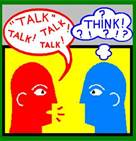
The exercise works like this:

Partner A asks partner B the question, exactly as it appears, for B’s turn at answering. B responds with a quick answer of a few words or a few sentences for approximately ten or twenty seconds.

After B answers, A says “Thank you,” and asks the same question again. B responds with a new answer to the same question, and A says “Thank you” again.

If B says nothing after about twenty seconds, A merely says “Thank you,” and then asks the same question again. Use common sense for the timing, and let the exercise flow in a natural manner. A must not say anything but the question, exactly as it appears, and “Thank you” during B’s turn.

This process of A always asking the same question over and over again, and B always answering, goes on for five minutes.

Then, the partners switch, where B asks and A answers, in the same manner as above, again for five minutes.

After both partners work with the first question, they move on to the second question for five minutes each. Finally, they both work with the third question.

Questions:

While in the waking state or the sleeping dream state:

1.) Tell me a way you avoid experiencing your feelings.

2.) Tell me how you get in the way of fulfilling your intentions.

3.) What does it say about you and reality when you know you are dreaming?

In conclusion, you can become lucid by fully experiencing your difficult emotions, especially the strong ones that occur often. Remaining conscious of your heart-felt intentions in the moment can help them come true through the power of your expanded self. Finally, the implications of knowing you dream in the moment, or becoming lucid, can assist you in better understanding how you define yourself, your potential, and your world.

After you complete the exercise and reflect upon your results, post your comments and answers to share with others if you wish.

Appendix:

Sample answers:

While in the waking state or the sleeping dream state:

Question 1: Tell me a way you avoid experiencing your feelings.

I don’t stay in the present moment.

I justify them.

I discharge them, for example by yelling.

I see myself as too mature to have them.

I numb myself with too much food, etc.

I wake myself up.

Question 2: Tell me how you get in the way of fulfilling your intentions.

I don’t believe I can fulfill them.

I think I must do so in a certain way.

I focus on something going wrong.

I get caught up in activities.

I don’t make my intentions clear.

I think that I don’t have enough time.

Question 3: What does it say about you and reality when you know you are dreaming?

I can take risks.

I don’t need to struggle nor worry.

I view all that I experience as part of my expanded self.

I see unlimited possibilities.

I know that I exist as more than just the body that I currently experience.

I recognize a different reality in which I sleep.

References

[1]             Lucid Dreaming-Lucid Living: Papers and Work of Beverly D’Urso.

http://wedreamnow.info/

[2]             The Ridhwan Foundation. The nonprofit spiritual organization established to support and preserve the integrity of the Diamond Approach teaching.

http://www.ridhwan.org/

[3]             Could You Be Dreaming Now? D’Urso. D’Urso, Beverly (Kedzierski Heart).

Workshop Presented at the IASD PsiberDreaming Conference, September 2011.

http://wedreamnow.info/?p=294

[4]             Lucidity and Self-Realization through Emotional Surrender. D’Urso, Beverly (Kedzierski Heart). Paper Presented at the IASD 29th Annual Dream Conference, Berkeley, CA., June 2012.

http://wedreamnow.info/?p=384

[5]             The Unfolding Now: Realizing Your True Nature through the Practice of Presence. Almaas, A.H., Shambhala, June 2008.

http://ahalmaas.com/Books/unfolding_now.html

Thursday, September 13, 2012 Categorized under Basic

Lucidity and Self-Realization through Emotional Surrender

Lucidity and Self-Realization through

Emotional Surrender

Beverly (Kedzierski Heart) D’Urso, Ph.D.

Presentation at the International Association for the Study of Dreams (IASD) Conference, Berkeley, CA, June 2012.

Copyright 2012

When we fail to internally experience a strong emotion in our bodies completely, life seems to give us more opportunities to do so in both our waking life and in our sleeping dreams.

We experience new dramas or dreams, sometimes with different characters and environments, but similar emotions. If we pay attention, we can notice patterns of such recurring emotional dramas or dreams.

I will give personal examples of dealing with such emotional dramas and dreams, and compare my lucidity work to a contemporary, psycho-spiritual teaching of self-realization.

As a child, I learned to become aware of such patterns in the form of recurring dream nightmares. When I found myself in a similar dream drama, I recognized it as part of the pattern.

I fully faced my fear, my dream nightmares ceased, and I became ‘lucid’ in a dream for the first time. I connected to the dreamer of the dream in a way similar to how spiritual teachings describe connecting to our true self, sometimes called the creator of life.

1:16

Decades later, I discovered what likely caused my recurring nightmares. I will briefly describe the initial incident and the recurring dream. Even if you’ve heard my dream before, listen carefully to the details.

I have a relatively clear memory at eighteen months old. My father always left for work in the early morning. He’d come in my room and kiss me goodbye. One morning, I decided to hide from him. Because of this, or more likely because he was running late, he left the house without kissing me goodbye.

I remember feeling extremely upset, probably believing it was my fault. Viewing the kiss as extremely important, I ran out of my room and through the house to the front door.

2

My father had not locked it, so I pulled it open and continued to run. I did not know about steps yet, and therefore ran right over eight stairs, and crashed, landing on my back on the cement at the bottom.

This memory ends here. In actuality, someone took me to the nearest hospital and discovered that I had broken my collarbone.  I had to remain in the hospital, and at that time, parents were not allowed to stay overnight in the hospital with their child.

In my second memory, my parents are waving goodbye at the hospital room door. I am standing alone in a crib, crying intensely. I sense that nurses are hovering over me. One gives me a saltine cracker. I can still clearly see how the cracker in my hand is getting soaked and mushy from my tears.

I can’t say that I definitively remember my dreams for the next few years, but by about the age of five, it seemed like I had had my recurring nightmare forever. It goes like this:

3

I’d find myself in my bedroom, and without notice, gruesome witches would sneak out of my closet and come after me.  I’d scream and run through the house, making it to the back door.

I’d fall down the back stairs, landing on the cement at the bottom, spread eagle on my back. Just as the witches seemed about to devour me, I’d wake up.

After years of this same recurring dream, I’d find myself pleading, as I lay on the cement with the witches hovering over me, “Please, spare me tonight.  You can have me in tomorrow’s night’s dream!”  At that point, I’d wake up.  However, the dream was still very upsetting, and I always hated going to sleep.
One hot, sticky summer night, at the age of seven, I felt especially afraid of going to sleep. Still being awake in the middle of the night, I grabbed an old, dark pink, American Indian blanket, put it on the floor of the living room, and fell asleep.

4

In the same recurring dream, I found myself back in my bedroom and noticed the closet door creaking open.  I knew at once the witches were coming for me, and I ran for my life.  I barely made it through the kitchen, fell down the back stairs, and landed on the cement.

The horrifying witches caught up with me, but the instant before I started to plead with them, the thought flashed through my mind, “If I ask them to take me in tomorrow night’s dream, then I must be dreaming now!”

I looked the witches straight in the eye and said, “What do you want?”  They gave me a disgusting look and I continued, “Take me now.  Let’s get this over with!”

Keep in mind that they still appeared just as scary, and I did not know what would happen. I watched with amazement, as they quickly disappeared into the night.  I woke up feeling elated.  I knew they were gone.  I never dreamed about witches this way again.

5

It pays to note that some lucid dreamers may have first turned the witches into less scary beings before dealing with them, destroyed them, or merely escaped from them.

I believe that my choice of surrendering to my fear, controlling only my reaction, and leaving the witches to do what they pleased, served as an excellent choice for my first lucid dream.

I not only ended my witch nightmares, but eventually I learned to deal with the witches again by bringing them back into my lucid dreams because they became my creative power.

At least as important, this experience taught me that I could know that I was dreaming while dreaming, and I continued to do so my entire life. I did not actually know the term lucid dreaming until my twenties, when I met Stephen LaBerge, and did research with him at Stanford for decades on this topic.

6

Now, let us come back to the present day. I have been studying a psycho-spiritual teaching for several years, and recently joined their seminary. This teaching describes a process called the theory of holes.

The theory of holes explains how earlier in life, when we could not completely handle an emotion, we would develop a related psychological hole. We try to fill the hole with external obsessions, such as taking drugs, overeating, or having superficial relationships.

We don’t allow room for ‘aspects of our true essence,’ such as love, peace, or compassion to arise. We get many chances to face up to the emotion in new recurring dramas in our waking life or, as I am introducing today, in our dreams.

When we finally do so, and completely experience our empty hole, aspects of essence finally arise to fill it. In a sense, we replace emotions of our personality with experiences of our true, realized self.

7

So, in my case, when I could not handle the extreme emotions that arose when I got left in the hospital and had to separate from my parents, at eighteen months, a hole got created. I may have temporarily filled this hole with external comforts, such as always needing to have my parents near me.

Nonetheless, when I faced the witches at age seven, I experienced the hole, or the psychological emptiness, which likely resulted from my painful experience at eighteen months of age. By doing so, I gained the powers that people often experience when they become lucid in a dream. I believe that these powers, such as strength, will, and joy, match the aspects of essence from the theory of holes.

As an adult, I finally recognized the amazing similarities between my early waking state experience and my resulting sleep state nightmares, even though the characters and set of the scene changed slightly.

For example, in my recurring nightmare, I ran from the witches instead of towards my father. The witches likely played the part of the nurses, who I originally saw as the bad guys. I ran to the back stairs instead of the front stairs, as I did at eighteen months old.

8

Still, the emotion remained the same, as did the main plot of both scenarios. I had many chances, to face my fear as the dream got repeated for years.

So, now I will jump ahead to the mid 1980’s, when, though a series of experiences, I decided to view waking life as a type of dream. As in my sleep state, I live in this waking dream with various levels of lucidity, or consciousness. I call this lucid living and have presented on this topic for over twenty-five years.

In this waking dream, or what gets called life, dramas also get created as they do in the sleep state. They seem to repeat until I completely face the difficult emotion from when the drama originated. I believe that I really connect to my spiritual teachings because they seem to say what I have been describing for years.

9

I will now explain some other repeating situations in my waking dream. For example, in many romantic relationships during arguments, my partner would seem to hover over me and look very scary, similar to the hovering witches of my childhood. One time, while this was happening, I asked myself, “What if I am dreaming right now?”

Instead of arguing back, I saw my partner as an aspect of my realized self, the Dreamer of life. I began to listen more, felt less afraid, and surrendered to the experience. My partner then did exactly what the witches did when I became lucid in my sleep state dream. He just disappeared out of my life.

For another example, as a child in the waking state, my best friend moved away, but the emotion of getting abandoned, or left behind, remained. I imagine that this experience, and others from a younger age, affected the way I often felt during romantic breakups. Breakup experiences kept repeating in my waking life.

10

I also noticed how my non-lucid dreams recreated romantic breakups. Sometimes the dream character looked just like my partner in my waking state. However, sometimes character reminded me of someone else.

The scene may also have seemed different, but the emotion remained the same. Once I really let myself internally feel the emotion of abandonment in my body completely, romantic breakups ended, and I met my husband of twenty years.

I have often stated that the night I met my husband I became the most lucid of all. Earlier that evening, I actually told a friend that I was giving up trying to meet a partner. I surrendered to my current situation as a single woman completely. Instead of acting needy or incomplete, I experienced the peace and joy of my true self.

11

However, without even thinking, I went up to a guy I saw from across the room, and did not focus on fears or plans. I remained extremely present and in the moment. I felt unlimited potential.

We stayed together from that night onward. Although we do have disagreements, I must say that he has never hovered over me in anger, as did my previous partners and my scary childhood witches.

Nonetheless, early on in our marriage, I used to get disappointed at my husband when he acted the way my father acted early on in my life. I did not actually see my husband at these times. I internally replaced him with an image of my father and over reacted.

12

Once I faced the disappointment I had for my father at an age when I seemed helpless, my disappointment toward my husband dissipated. In a sense, I may have tried to fill a hole with my husband’s affection. However, I could only stop my disappointment toward him, when I surrendered to the deeper feelings of the original disappointment, and allowed kindness and compassion of my true self to enter.

To work with sleeping dreams or waking dramas in this way, I first look for recurring emotional themes. As I have shown, they can come from sleep state dreams or from the waking state. I don’t necessarily need to get lucid, but it helps.

I merely focus on really feeling the related emotion deep inside my body in the moment, without discharging it, for example, with loud yelling. If that seems too difficult, it can help to express my feelings outwardly later on, in a safe environment.

13

I have learned that whenever I feel any emotion strongly, it probably means that I have an unresolved emotional experience that I am projecting on the present situation. Even if I can’t recall a past, related event, I just try not to resist the current emotion, nor use something to numb my experience, such as food or sleep.

I try not to tell myself that I have matured beyond such childish feelings. I especially notice if I am blaming someone else for my current state.

Note that the unresolved emotion can originate from an experience at a very early age of which I have no clear memories. Perhaps I did not get fed soon enough as an infant, or got fed on a schedule that did not match my needs.

14

My spiritual teachings have much more to say about all this, as the seminary to become a teacher takes well over ten years. If you have an interest in this path, you can find a reference in my online abstract for this conference.

In conclusion, to become self-realized, or to connect to my true self, in the waking state, I can practice by connecting to the dreamer in my sleeping state. When I allow, and then surrender to, ‘so called’ negative states, I may first experience what seems like pain or emptiness.

However, I soon become open to “so called” positive states, or aspects of essence. I have discovered that my truly lucid self, or realized self, only experiences such positive states. I definitely love living in this way in waking or sleeping dreams, which I call the most lucid of all!

Now, I’d like to demonstrate this surrendering process by describing a dream that I plan to present at Tuesday night’s dream ball.

“I dreamed myself as a wave, and you as a wave as well. We seemed separate with this space between us. Suddenly, we became lucid and let ourselves fall into this hole. We surrendered into emptiness, and as water filled the hole, only a calm sea remained as our true self.”

15

Thank you.

Questions?

Lucidity and Self-Realization

through Emotional Surrender

by

Beverly (Kedzierski Heart) D’Urso, Ph.D.

Proposal for the 2012 Association for the Study of Dreaming Conference,  Berkeley, CA, June 2012

Copyright 2011

Summary

When we fail to internally experience our emotions completely, dramas involving similar emotions appear in our life and in our dreams. I will give personal examples of dealing with such recurring emotional dramas, breakdown the steps involved, and compare my lucidity work to a contemporary psycho-spiritual teaching of self-realization.

Abstract

When we fail to truly experience a strong emotion in our bodies completely, life seems to give us more opportunities to do so in both our waking life and in our sleeping dreams. We experience new dramas or dreams, often with different characters and environments, but similar emotions. If we pay attention, we can notice patterns of such recurring emotional dramas or dreams.

As a child, I learned to become aware of such patterns in the form of recurring dream nightmares. When I found myself in a similar dream drama, I recognized it as part of the pattern. I fully faced my fear, my dream nightmares ceased, and I became ‘lucid’ in a dream for the first time. As my dream-self expanded into the dreamer, I gained powerful abilities and positive qualities, such as will, joy, and peace. I now understand that my recurring nightmare evolved from an accident I had in the waking state at eighteen months old. At that time, I could not deal with the strong emotions that arose during the drama of the accident.

As an adult, I experience lucidity in my waking life, as well as in my sleeping dreams. I call this ‘lucid living.’ Currently, I am studying a psycho-spiritual teaching that describes a similar process called ‘the theory of holes’. This ‘theory of holes’ explains how earlier in life, when we could not completely experience an emotion, we would develop a related psychological ‘hole.’ We try to fill the hole with external obsessions, such as taking drugs, overeating, or having superficial relationships. We don’t allow room for ‘aspects of our true essence,’ such as love, strength, or joy. We get many chances to face up to the emotion in new recurring dramas in our waking life. When we finally do so, and completely experience our empty hole, aspects of essence finally arise to fill it. I will show how we can use this process in our sleeping dreams as well.

As an analogy, imagine our ‘Creator,’ which I call the ‘Dreamer of life,’ as the sea and people as the waves. During lucidity, a wave expands DOWN into the sea knowing unlimited possibilities and self-realization. In the ‘theory of holes,’ the deep water of the sea, our ‘true nature,’ can represent aspects of essence. The waves represent people with holes. When we fully experience our emotions and face our empty holes, the deep-sea water rises UP to fill them. The waves finally realize themselves as the sea. When the water overfills the holes of all the people in the world, or we all become lucid, only a peaceful sea will exist as the potential of God.

All audiences can relate to this presentation, which should increase self-awareness and emotional growth.

REFERENCES:

‘Emotions in Dreams Lead to Self-Realization,’D’Urso, Beverly (Kedzierski Heart), Workshop Presented at
The Association for the Study of Dreaming: PsiberDreaming Conference, September, 2010.

http://durso.org/beverly/emotions_in_dreams/emotions_in_dreams.html

‘Essence With the Elixir of Enlightenment: The Diamond Approach to Inner Realization,’ Almaas, A.H., Weiser Books, York Beach, Maine, March 1, 1998.

http://ahalmaas.com/


Tuesday, October 25, 2011 Categorized under Lucid Living

“Could You Be Dreaming Now?”

“Could You Be Dreaming Now?”

by Beverly (Kedzierski Heart) D’Urso, Ph.D.  Copyright  © 2011

Presentation for the 2011

International  Association for the Study of Dreaming

PsiberDreaming Conference

http://www.durso.org/beverly/

http://www.wedreamnow.info

Do you tend to label the ‘waking’ state as distinct from the ‘dreaming’ state? What if you actually ‘dream’ while in the waking state? Try referring to everything you ever experience as ‘dreaming,’ and deciding that your experiences differ only in your level of lucidity. You could then continuously apply lucidity techniques and lessons from sleeping lucid dreams to enhance your life. In this session, you will examine your current level of lucidity, which could lead to discovering a new aspect of yourself and new way to view your world.

dreambed

Research on lucid dreaming shows that brain waves during REM sleep, the state in which you often dream, look remarkably like waking state brain waves. Tests can show whether or not you are sleeping, and if you are dreaming while sleeping, but not necessarily that you only dream in the sleeping state. Therefore, consider this theory of why you dream: You have the capability and need to dream in the sleeping state, in order to help you remember that you dream in the waking state. In a sleeping dream, it appears that your physical self, an expanded self you can call the ‘dreamer,’ dreams up your dream self. In a similar manner in the waking state, you might actually get dreamed up by an expanded SELF, which you can call the DREAMER of your life. You may actually exist as an aspect of the DREAMER, just as in the sleeping state your dream self exists as an aspect of you, the dreamer. This DREAMER produces the drama in your life and creates your world, which you can call a ‘dream.’

If you want to have a sleeping state lucid dream, you might practice answering the question, “Could you be dreaming now?” in the waking state so that your dream self would eventually answer it while you were asleep and dreaming. Your dream self might respond in the positive, expand consciousness, and get lucid, while you remain in the sleeping state. In other words, your dream self expands into the dreamer, and you know you are dreaming in the sleeping state, the actual definition of lucid dreaming.

In a similar way in the waking state, if you answer the question at least partially in the positive, you would expand consciousness and get lucid while you remain in the waking state. In this case, you have expanded into the DREAMER, and YOU know that YOU are dreaming in the waking state. This is also called lucid living (D’Urso, 2007).

Some Eastern religions, as well as Western philosophies, focus on the ‘negative’ aspects of seeing life as a dream, such as illusion or projection. (See APPENDIX A: The Dream Argument.) These are comparing life to non-lucid dreaming. This session looks at the ‘positive’ aspects of seeing life as a dream by concentrating on lucid dreaming. When lucid in the waking state, YOU experience YOURSELF as a producer of YOUR life instead of as a mere character. Just as in sleeping lucid dreams, YOU can get more lucid and move through ‘blocks’ that seem to restrict YOU in YOUR waking state. Flying through walls in a sleeping lucid dream, and discovering the power that you lost as a child in your waking lucid dream, both demonstrate ‘moving through a block.’

DREAMER

How do you become lucid in your waking state? You can use the ways you become more lucid in the sleeping state (D’Urso, 2007). For example, (1) practice becoming more aware or present and look for unusual situations; (2) answer the question, “Could you be dreaming now?”; (3) review recurring scenarios; (4) record, share, and study your life/dreams; (5) set lucidity goals; and (6) ‘act as if’ you are dreaming. This last technique does not mean to take unnecessary risks. Merely consider what might seem possible, and how YOU might act and respond, if YOU were dreaming. (See Appendix B: Beverly’s personal examples of lucidity in the waking state.)

Practice becoming more aware, not only of what your senses take in of your surroundings, such as sights and sounds, but of your body sensations and energies. You can notice lucidity as a very deep sensation, especially if your mind seems clear and lacks a continuous stream of thoughts involving the past and the future. In other words, experience presence. You can help clear your mind by practicing meditation, or by sensing your arms and legs instead of focusing on your head (Almaas, 2008).

Most importantly, answer the question as often as possible: “Could you be dreaming now?” with awareness of what this might imply. This question gets asked by the dreamer, your physical self, in the sleeping state and by the DREAMER, your expanded SELF, in the waking state. In effect, in both states, you are being asked if you are being dreamed up right now. Merely questioning if you are dreaming, in the sleeping state or the waking state, can get you to a certain level of lucidity. Remaining open to the possibility that you are dreaming brings you to yet another level.  Remember, contrary to many beliefs, you do not need to ‘control’ your dream for it to have lucidity. The appearance of control only shows that the level of lucidity has changed. At some levels, you may not even experience a body nor an environment, and yet come back to a place of amazing peace, strength, and joy (D’Urso, 2009).

So, “Could you be dreaming now?”

If you feel certain that you know you are not dreaming, you might miss out on experiencing the exhilarating, creative, and potent ‘magic’ that lucid dreaming can bring to every moment. See if your answer changes if you ask, “Could an expanded SELF be dreaming you up right now?” Can you see how these two questions relate? Do you label people who do not know they are not dreaming as crazy, or do you view people who know they are not dreaming as more sane?  When did you first learn the concept of ‘dreaming’ or of being ‘awake’? Why do you need to see them as mutually exclusive? When you think you know you are not dreaming, do you sense that you have little control or total control over your life? Do you see unlimited possibilities in your life or do you believe that some things are impossible? Do you view yourself as a separate individual without connection to others or do you really sense the oneness of everything?  Do you believe that you exist only as your body or do you sense yourself as more than this?

If you do not know for sure that you are dreaming, in other words you only have a belief that you are dreaming, you could say that you have some, but not much, lucidity. If you act dangerously upon this belief, you could experience disaster. For example, you could feel the pain of broken bones from jumping off a cliff in the sleeping state or in the waking state. This accounts for people that you may have heard of who perform dangerous actions because they thought they were dreaming, but did not know for sure. If you remain aware and sense your body, you’ll find many ways to help you determine that you are dreaming. Until you know for sure, however, don’t take unnecessary risks!

If you do not know for sure that you are not dreaming – if, in other words, you remain open to the possibility that you are dreaming – you have the potential for the ‘magic’ of lucidity while awake or asleep! So, stay with the question: “Could you be dreaming now?” What comes to mind? Have you noticed that you often repeat patterns from earlier in life over and over again like a recurring nightmare? If you were dreaming now, do you automatically think that the world around you would look fuzzy or more clear than if you were not dreaming?  What would you do or not do?  Would you feel more or less safe if you were dreaming or not dreaming?

If you know that you are dreaming, in the sleeping or the waking state, you can have amazing adventures and even get to a place of self-realization. The possibilities seem endless! At a certain stage of lucid dreaming, you might view having adventures in your lucid dreams as the primary purpose of lucid dreaming. For example, in a lucid dream of any state, you might start with asking yourself what you’d like to do next. Perhaps you have a goal in mind. You might ignore other possibilities, such as allowing yourself the sense of freedom and joy that you really want from the goal in the first place. While attempting your goal, you might get sidetracked. You might forget that you are dreaming, and decide that you don’t have the power to attempt the goal after all.  Something might seem to block you, and you might judge the goal as impossible. With more lucidity, however, you can eventually discover your inner strength, as well as understand the block.

Waking Self

To take lucid dreaming to a further stage, instead of focusing on adventures and goals, look at the implications of what it means to know you are dreaming, or that you are being dreamed up, right now. In a lucid life, as in sleeping lucid dreams: (1) YOU can ‘control’ YOUR life to some degree, but only because of YOUR expansion into the DREAMER. In a sense, the DREAMER can guide YOU if you don’t resist. (2) Seemingly impossible experiences can occur in YOUR waking state. YOU might experience extreme synchronicities, awesome psychic abilities, or amazing powers of strength or will. Think about the reported abilities of Jesus Christ, such as raising the dead and getting resurrected. Could his level of lucidity and his expansion into the DREAMER have something to do with his abilities? (3) YOU can sense YOUR oneness or connection with everything and everyone in YOUR life when YOU see each as an aspect of the DREAMER. (4) YOU can know YOURSELF as more than just YOUR physical body. Waking up out of a sleeping dream could even suggest that one day you might wake up out of your life. What do you think this implies?

Scientists say that while sleeping, you often experience dreams, usually in REM sleep, even though you may not remember them. They also show that you go into deep, non-REM sleep, as well. Apparently, you don’t usually dream in this deep state, and therefore you don’t really experience it. Your sleeping physical self dreams and then doesn’t dream, back and forth continuously. Therefore, by implication, the DREAMER may do the same, periodically manifesting life. Many human-developed systems do this as well. Computer programs ultimately work using an alternating series of 1’s and 0’s. Circuit boards have resistors that allow, and then don’t allow, electric flow. Could this on/off process explain how manifestation actually works? Studies that restrict REM sleep show that you do best in the waking state when, in the sleeping state, you have REM periods where you can dream and manifest worlds, even if you don’t remember doing so. Do you think the DREAMER does best by periodically manifesting life?

In conclusion, stay aware of your experiences; meaning your thoughts, feelings, sensations, and energies, in both the sleeping state and the waking state. Do not resist nor deny them even if they seem uncomfortable. Ask yourself if you have noticed these before. Understand where they come from (Almaas, 2008). Then, from a place of more lucidity, answer the question again: “Could YOU be dreaming now?” and “What does YOUR answer imply?”


Dream World

APPENDIX A: The Dream Argument (from Wikipedia)

http://en.wikipedia.org/wiki/Dream_argument

While people dream, they usually do not realize they are dreaming (if they do, it is called a lucid dream). This has led philosophers to wonder whether one could actually be dreaming constantly, instead of being in waking reality (or at least that one can’t be certain that he or she is not dreaming). In the West, this philosophical puzzle was referred to by Plato (Theaetetus 158b-d) and Aristotle (Metaphysics 1011a6). Having received serious attention in René DescartesMeditations on First Philosophy, the dream argument has become one of the most prominent skeptical hypotheses.

In the East, this type of argument is well known as “Zhuangzi dreamed he was a butterfly” (369 BC)…This was a metaphor for what he referred to as a “great dream”: …Confucius and you are both dreaming! And when I say you are dreaming, I am dreaming, too. Words like these will be labeled the Supreme Swindle. Yet, after ten thousand generations, a great sage may appear who will know their meaning, and it will still be as though he appeared with astonishing speed.

APPENDIX B: Beverly’s personal examples of lucidity in the waking state

A great example of using a lucidity technique in my waking life occurred when I noticed recurring scenarios of an argument during my romantic relationships before I got married. The last time this scenario occurred, I suddenly thought, “This seems like a recurring theme” and “Could you be dreaming now?” I immediately saw my partner as an aspect of the DREAMER, and considered his point of view and what he had to teach me. With trust and surrender, I stayed present.  Exactly as the witches did in my childhood nightmares when I faced up to them, my partner froze, stopped yelling, and then turned and walked away. I no longer needed to play out this drama and have not done so in the past twenty years.

I also acted with lucidity in my waking life when I set a goal of having a family. Acting as if I was dreaming, I believed in miracles instead of the terrible odds of having a family in my forties. I now have been married for eighteen years and we have a sixteen year-old son.

Often, I see how I block myself by reacting to my strong emotions, instead of just feeling and understanding them (D’Urso, 2010). When I stay present, and in the flow of what is happening without resistance, more possibilities eventually seem to open up.  I also find myself guided to what I could easily have missed: unusual situations ranging from finding perfect airplane reservations to noticing precognition. I share these with others on a daily basis.

REFERENCES

D’Urso, B. (2007). Lucid dreaming: A bridge to lucid living. Workshop, International Association for the Study of Dreams (IASD) Conference. Sonoma, CA.

http://durso.org/beverly/IASD_Workshop_2007.html

Almaas, A. H. (2008). The unfolding now: Realizing your true nature through the practice of presence. Boston. MA: Shambhala Publications.

http://ahalmaas.com/Books/unfolding_now.html

D’Urso, B. (2009). Levels of consciousness and lucidity while dreaming or awake. Presentation, International Association for the Study of Dreams (IASD) PsiberDreaming Conference. Online.

http://wedreamnow.info/?p=124

D’Urso, B. (2010). Emotions in dreams lead to self-realization. Presentation, International Association for the Study of Dreams (IASD) PsiberDreaming Conference. Online.

http://wedreamnow.info/?p=181

Tuesday, November 9, 2010 Categorized under Emotions

Emotions in Dreams Lead to Self Realization

Picture of All Emotions

Emotions in Dreams Lead to Self Realization

by Beverly (Kedzierski Heart) D’Urso, Ph.D.
Copyright  © 2010 Beverly D’Urso
Workshop Presented at
The 2010 Association for the Study of Dreaming  PsiberDreaming Conference
http://www.durso.org/beverly/
http://www.wedreamnow.info

My work in ‘lucid dreaming’ led me to conscious ‘lucid living.’ You could call this self expansion, or ‘Knowing the Self’ [1]. I now see how my emotional, non-lucid dreams assisted this process by helping to open both my mind and my body. As a child, I felt willing to totally experience great fear in what I call my first lucid dream. However, in my waking state and in my non-lucid dreams, I often could not fully experience simple upsetting emotions without any resistance, outward expression of blame, or inner guilt. I did not even have awareness of any resistance or judgment.

I have created a workshop where you can play with experiencing your emotions in the waking state, the dreaming state, and particularly the state of awakening. Together, we can discover another way to benefit from our dreams.

At this point, in both my waking state and in all my dreams, I aspire to fully experiencing my emotions instead of projecting them outwards or stuffing them inside. I don’t need to avoid them in order to appear more ‘mature’ or less ‘crazy.’ Dissolving or discharging them by experiencing them fully eventually leads me to a more peaceful and centered place [2].

I don’t think I really ‘processed’ my feelings during past painful life incidents, especially during childhood. Interestingly, I am spontaneously having non-lucid dreams where I experience an uncomfortable incident over again. These dreams give me a chance in the dream, or just as I wake up, to fully feel my emotion without resistance or judgment. I notice how the emotion affects my body, my breathing, and my thoughts, and likewise, how these three affect my experience of the emotion. I believe that this process has removed many barriers to my experiencing a more whole and loving self.

Notice that the above process merely takes ‘awareness.’ In this workshop, I will also ask you to attempt to induce dreams and modify dream conditions if you become lucid. However, you do not need to do so to participate. Even if you don’t admit to having emotions or dreams, or you see emotions as ‘childish,’ play along and use your imagination. You may get enlightened.

Do the following exercises and report what happened. You can choose or use any emotions. If you don’t want to deal with uncomfortable emotions, you can choose feelings, such as joy or compassion. Keep in mind that a joyful experience can lead to self expansion, but you may see more amazing results by facing up to a feeling that you normally resist.

During the day:

Remain aware of any uncomfortable or frustrating feelings, or joyful ones, if you choose. When possible, stop what you are doing. Really feel the emotion that comes up for you. Immediately scan your body and breath. Notice your thoughts and your environment, including other people.

Argue PictureTo start, you can label the emotion.For example, say to yourself, “I really feel hurt.” Do not try to focus on any thoughts such as, “He did not act fairly.” Aim at not replaying the ‘story’ of what happened or expanding the emotion. Your emotions may seem out of proportion because another person may have triggered a past emotion that never got discharged. See an example of this in Appendix A.

Next, relax and move any stressed muscles. Slow down, lengthen, or quicken your breathing. Do your feelings change? At the end of the day, review what happened and post your experiences on this thread.

At bedtime:

If you so desire, do what you can to intend or incubate a dream with emotion.You can even choose to dream of a past incident when you did not fully experience an emotion, such as a feeling that might arise at the end of a relationship.

Broken HeartIntend to pay close attention in your dream to how you are experiencing your feelings and noticing your body, breath, thoughts, and environment, as you did in your waking state. The waking state exercises should help you remember to do this. Experience and notice all of these NOW, and remind yourself to do so as soon as you begin to wake up.

During the dream:

For lucid dreamers: if your intention does not manifest at the start of your dream, you can call forth the people from the incident, or go to the place where the emotional experience occurred. Replay the scene as much as possible. Rather than tell yourself, “I am merely dreaming,” really delve into any feelings, such as fear, anger, hurt, or joy. You do not need to resist the feelings, project blame, or take on guilt. However, do not resist any resistance or judgment. Merely stay aware of them. Lucid dreamers can also start breathing differently, stretching, or moving around. See the example lucid dream in Appendix B.

When you awaken:

Most importantly, for all dreamers: as you awaken, look for and stay with any emotion you just had or are still experiencing. You can do this many times during the night, or just before you get out of bed. Even if you don’t remember any dreams or feel any emotions, stay with your experience and pay attention to your thoughts, body, breath, and environment.

If you do remember a dream, do not focus on the ‘story,’ but pay attention to the feelings you had or still have. If it happens naturally, let out any tears or grunts. However, do not amplify the feeling, especially by thinking of the details of the dream, such as what you or another person did or said. Determine or distinguish the feeling. Do you feel hurt, frustrated, sad, or peaceful?

Picture of All Emotions

What do you notice or feel in your body? Do you sense anything particular in any part of your body, such as tenderness in your heart area or tension in your head? Notice your arms and legs, and then move or stretch them. Slow down, lengthen, or quicken your breath.

Did moving your body or changing your breath change your experience? If convenient, record what happened right away. Post your experience on this thread as soon as possible.

I intend to respond to each post without analyzing or judging you, but by merely sharing my observations. I will do so throughout the conference, so you can participate any time, as often as you like. I suggest that you start NOW.

APPENDIX A: Waking State Experience with Hurt Feelings

While creating this workshop, I got a phone call from a close, long-term friend. She told me that she could no longer associate with me because she feels that I act rudely by not politely eating whatever I get served. She also said that she could not handle the way I talk about my eating habits. (I gave up eating meat a year ago, and I eat more vegetables.)

Picture of Woman Crying

As I heard her ending our relationship, I immediately felt extremely sad and began to cry. She sounded harsh and uncaring. My throat tightened up. While sobbing, I told her that I heard her, and felt glad that she was finally telling me how she felt. Between gulps of air, I said it made sense not to give unsolicited information about my eating habits. I also said that I cared about her and respected her. However, I did not hold back my hurt feelings. I told her that I did not blame her for my feelings. I explained that I have been practicing to feel my emotions deeply.

I did not feel guilty or ‘childish,’ and I aimed at not defending myself. I saw it as important for her to experience her own feelings. I did, however, ask her if she wanted to hear a few words about my point of view, a misinterpretation, concerning a situation that she had described.

I noticed that I was sitting in a crouched position, so I moved to another room and stretched out. I took some slow, deep breaths, and noticed a slight tremor throughout my body. I moved my legs back and forth.

After the call, I let myself continue to cry, and felt that I had fallen into an abyss. I remembered that I felt a similar way when my parents had to leave me overnight in a hospital at the age of eighteen months. The sobbing and choking-up felt familiar. I imagined that my friend’s feelings also related to her own past experiences.

I looked around, and saw that I was lying among boxes of junk that I had not yet cleaned up. After a while, I felt a sense of relief, openness, and energy.

APPENDIX B: Dream State Experience with Joyful Feelings

While creating this workshop, I had the following dream:

I am interacting with my son and notice that his height exactly matches mine. Because he has surpassed my height by about six inches in my ‘waking’ state, I realize I am dreaming. I ask him if he can lower his height and become about two or three years Picture of WomanMovingold.He does this, and we begin to laugh and play as we often did some twelve or thirteen years ago. I feel full of joy and excitement. We dance around the room, which appears large and empty, swinging our arms and legs all around. My breath feels full and open. I have tons of energy.

http://www.durso.org/beverly/
http://www.wedreamnow.info

REFERENCES

[1] “Levels of Consciousness and Lucidity while Dreaming or Awake.” Presentation for the 2009 International Association for the Study of Dreams (IASD) PsiberDreaming Conference (PDC2009). http://wedreamnow.info/?p=124

[2] Almaas, A.H. (2008). The Unfolding Now: Realizing Your True Nature through the Practice of Presence. Boston, MA: Shambhala. http://ahalmaas.com/Books/unfolding_now.html

Monday, March 29, 2010 Categorized under Lucid Dreaming

Levels of Consciousness: Proposal, Paper, Workshop

levels picture

Levels of Consciousness and Lucidity while Dreaming or Awake
by Beverly (Kedzierski Heart) D’Urso, Ph.D.
Presentation for  the International Association for the Study of Dreams (IASD) PsiberDreaming
Conference (PDC2009)   Copyright  © 2009

http://durso.org/beverly/

PROPOSAL

My paper will refer to a chart which describes levels of consciousness, including lucidity. I’ll start with what I call contracted, or low level of consciousness. At this level, I do not reflect upon what I do. When I act in the waking state or the dream state at this level, I may blame, suffer, have fun, or just plain not pay attention. In the sleep state, I may have dreams, but I do not recall them. However, when I notice in life, after the fact, that I have acted, for example, in hurtful ways, I fall into the level I call reflection. I do not have enough consciousness to notice or change my actions in the moment, but I can recall life issues or dreams from my past and begin to learn from them.

When I question my reality and my assumptions, my consciousness expands.  I call this level semi-lucid. In the sleep state, this corresponds to questioning if I am dreaming. The next level I call lucid. In the waking state, I really know my unpleasant thoughts as untrue assumptions. When I know I am dreaming in the sleep state my fear decreases and my mind clears. If I question my assumptions, especially when I do not feel positive about what I am experiencing, it can help me respond in more appropriate and creative ways, and I become what I call  more lucid. At a very lucid level, I can co-create interesting dramas in my life and dreams in my sleep. In my final level of lucidity, I would still experience a dualist world, but really know all parts as One. I call this the level of most lucidity. In some sleeping dreams, I feel that I go beyond lucidity. I no longer have a body nor an environment. For now, I aspire to come from an expanded level of consciousness, or lucidity, in every moment, whether awake or asleep.

Levels of Consciousness While Dreaming or Awake – PAPER
by Beverly (Kedzierski Heart) D’Urso, Ph.D.   Copyright  © 2009

http://www.durso.org/beverly/

I define the term dream as an experience of an outer world made up of characters, actions, and environment that my expanded self, a collective mind of nonphysical form, has helped to create. I see life in the same way.

Lucid dreaming occurs when I know that I dream while I dream. When asleep and lucid dreaming, I see my whole environment including my dream body and others, as untrue, particularly in relationship to my waking state. When I call something ‘untrue,’ I mean that I let go of my assumptions and no longer see it as real or solid or true. By ‘untrue,’ I do not mean false, but rather ‘I  don’t know for sure.’

When awake and lucid, I also see my whole environment including my physical body and others, as ‘untrue’ in relationship to my expanded self.  In other words, I might say: “My expanded self is dreaming when Beverly seems ‘awake.’”

People have associated lucid dreaming with ego control and satisfaction. I will show how lucidity actually relates to expanded states of consciousness, and what it means to have lucidity in our dreams and in our lives.

I will refer to the chart in  APPENDIX B, which I have divided into columns for the waking state and the sleeping state. It describes three major levels of consciousness: non-lucidity, lucidity, and beyond lucidity. Note that in the non-lucid levels, I list actions that obviously do not happen in the sleep state, but merely relate to it.

I can act from any of these levels of consciousness at any moment, while awake or asleep. Also, at the higher levels, I still have access to the abilities of the lower states. For example, in a most lucid state, I can still change my responses. At different times in my life, I may have dreams that I don’t even recall, while in my waking state I seem very lucid. The opposite can occur as well. Also, I often lose and gain lucidity in a single dream.

The first two levels fall into non-lucidity. I will call the first, low-level of consciousness: contracted. At this level, I do not reflect upon what I do. When I act in the waking state or the dream state at this level, I may blame, suffer, have fun, or just plain not pay attention. In the sleep state, I may have dreams, but I do not recall them.

However, when I notice in life or in dreams, after the fact, that I have acted, for example, in hurtful ways, I fall into the level I call reflection. I do not have enough consciousness to notice or change my actions in the moment, but I can recall life issues, or dreams from my past, and learn from them. In this state, I remember dreams only after they happen and, therefore, they get called non-lucid dreams.

For example, to reduce my tendency to always blame others in the waking state, I may seek therapy.  To learn from my dreams, I may join a dream group.  In this reflecting level, I still may feel limited, especially when my experience seems uncomfortable or unloving.  I see my world as unchangeable.

At this level in the waking state, I might feel justified in feeling hurt that my husband often criticizes me, and therefore he must not care about me. I may go as far as assuming that if he does care about me, he will leave me, and I will perish. Without a higher level of consciousness, I could feel very depressed, and might act in an angry manner towards him and others. I could actually help make this scenario my experience.

In a sleeping dream, I might try to run away from some scary monsters that chase me while I focus on my dream body’s thought that they will devour me.  Afterwards, in the waking state, I might figure out ways in which I can deal with the monsters next time in these nightmares.

I will refer to the next levels of consciousness as lucidity. Whether awake or asleep and dreaming, when I really pay attention to my environment or my body, I have a greater sense  of aliveness or stillness. When I question my reality and my assumptions, my consciousness expands.  I call this level semi-lucid.

In the previous example about my husband, I might ask, “Is it absolutely true that my husband does not love me?” At this point, I could look for ways that he acts as if he does love me and for ways that I act as if I do not love him. I could also inquire about how I act and feel when I have the thought: “My husband does not love me,” and how I act and feel when I do not.

In the sleep state, I might to question if I am dreaming. Even if I do not believe that I am dreaming for sure, just the mere act of questioning brings me to this semi-lucid level. In a recent dream, I wondered if I was dreaming so I tried to float. I could not float, but I could tell that the water I was drinking did not taste ‘wet’ as it seems to in my waking state.

The next level, I call lucid. In the waking state, I really see my unpleasant thoughts as untrue assumptions. With even partial lucidity, I find that small frustrations disappear quickly, and I experience more fulfillment. I focus more on the present moment, and feelings of ambition or regret don’t come up. Time tends to disappear.

When I know I am dreaming in the sleep state, in other words when I see my dream world as untrue, my fear decreases and my mind clears. I do not have to do anything, but merely realize that I dream while I dream. At this lucid level, I often experience expanded potential and more awareness. I believe that most people are referring to this level when they use the term ‘lucid.’

If I question my assumptions, especially when I do not feel positive about what I am experiencing, it can help me respond in more appropriate and creative ways, and I become more lucid. My response to what happens comes from my expanded self. I can accept what is happening and easily surrender to, and fully face, painful or scary situations.

I have done this in my waking state when a doctor told me I needed a procedure. I insisted I would not go through it. Finally, my doctor said that, “It’s like I see you on a cliff about to fall, and I want to keep you from doing so.” I often recommend to my students not to jump off a cliff unless they really know they are dreaming, so I told him to proceed. However, seeing this common dream theme, I suddenly did become more lucid. Instead of focusing on my fears and thoughts of pain, I became calm and accepting, thereby making the whole process much easier. Then, like magic, I began to see  numerous sychronicities.

In my sleeping dreams, I have often become more lucid right before a head-on automobile collision. Right before impact, I realize I am dreaming, and I might instantly fly up into the sky or even wake myself up.

At this more lucid level while awake or asleep and dreaming, I also notice that my view of how others act towards me may reflect how I act or have acted toward them, others, or myself.  So now, in my waking state, as well as in my sleeping dreams, I attempt to listen carefully to what others have to say to me. Even if I feel hurt, I may try to find ways to show I agree with them, instead of just defending myself.

At a very lucid level, I can co-create interesting dramas in my life and in my sleeping dreams. My expanded self has the awareness that what it expects seems to happen. If I do see or hear something that I don’t like, such as a broken tooth or a critical comment, I can attempt to heal my body or learn from the comment. I can fearlessly accept such ‘imperfections’ as a part of myself that can teach me what I need to learn.  Some lessons I have learned in my sleeping dreams also seem to enhance my waking life, and vice versa. I believe that many people unrealistically expect to get to this very high level of lucidity the first time they attempt lucid dreaming.

In my life, I feel that lucidity has helped me fulfill many lifelong goals, such as finishing my Ph.D., finding a mate, having a child, dealing with grief, and healing my body. I did these things with an attitude of presence, acceptance, and intention, and not with what gets called ‘will power.’ (See REFERENCE 2.)

At a very lucid level in my sleeping dreams, not only do I not experience fear when ‘attacked’ by ‘monsters,’ but I can do things, such as fly through walls. I can have these experiences because I don’t see the monsters or the walls as ‘true.’

Once, in a very lucid sleeping dream,  I thought: “I would love to be sitting in a boat on this lake in the distance.” Instantaneously, I found myself on such a boat in the lake. Others have talked about this process occurring in the waking state and call it ‘manifestation.’ However, in the waking state, with my time/space beliefs, I seem to experience a time delay not necessary in my sleeping dreams.

In my final level of lucidity, I still experience a dualist world, but really know all parts as ‘One.’ I call this the level of most lucidity. I believe that many spiritual teachers experience this state of no separation and a connection between everything in their waking life.

In my sleeping lucid dreams, I have often viewed everyone and everything, including my own dream body, as ‘One.’ Many years ago, in a sleeping dream, I was giving a presentation at a dream conference and suddenly stopped when I became most lucid. Losing some lucidity, I assumed that all the people in the audience existed only in my ‘head,’ so I felt I had no need to continue presenting. Now, I refer to ‘others,’ as well as my dream body, as all parts of an ‘expanded self,’ which  flourishes as all the parts develop.  When I experience the most lucidity, I see these ‘others’ experience lucidity as well.

In some sleeping dreams, I feel that I go beyond lucidity. I no longer have a body nor an environment. I merge into vibration, sound, and light, and then into nothingness, or what I also call everythingness. I could describe this as expansion into ‘Being,’ or ‘Source’ or ‘God.’ I prefer the term ‘Dreamer,’ with a capital ‘D.’ For now, I aspire to come from an expanded level of consciousness in every moment, whether awake or asleep.

APPENDIX B

CHART OF  LEVELS  OF  CONSCIOUSNESS

WAKING                                SLEEPING

Non-lucidity

Contracted
No reflection                            No dream recall

Reflecting
Recall past issues of life            Recall non-lucid dreams
Study your life                            Study your dreams

Lucidity

Semi lucid                    Question thoughts                    Question if dreaming

Lucid                            See thoughts  as untrue            See dream world  as untrue

More lucid                    Change responses in life           Change responses in dream

Very lucid                     Change life                                Change dream
and potentially change life

Most lucid                    View all in life  as ONE            View all in dream  as ONE

Beyond lucidity
Unity                                         Non-Duality

REFERENCES

1. “Lucid Dreaming/Lucid Living,” D’Urso, Beverly (Kedzierski Heart), Online Publications, 1982-2009.

http://www.durso.org/beverly/Index_of_Papers.html

2.    “My Lucid Lucid Life,” D’Urso, Beverly (Kedzierski Heart), Appeared as “Dream Speak: An Interview with Beverly D’Urso: A Lucid Dreamer” – Part One, Two and Three, “The Lucid  Dream Exchange,” Numbers 29, 30, and 31, 2003 – 2004. Also appeared in the online publication: “Electric Dreams.”

http://www.durso.org/beverly/My_Lucid_Life.html

BIOGRAPHY

Dr. Beverly (Kedzierski Heart) D’Urso, an “extraordinary” lucid dreamer all her life, has used her practical teaching called lucid living to give workshops and present at conferences for decades. She completed her Masters, involving Cognitive Psychology, and her Ph.D., focusing on Artificial Intelligence at Stanford University, where she also did lucid dreaming research. She has also created several startup companies, worked as a researcher, consultant, and a college professor, and has over sixty publications and several awards, including many IASD dream contests.

Levels of Consciousness and Lucidity While Dreaming or Awake – WORKSHOP
by Beverly (Kedzierski Heart) D’Urso, Ph.D.   Copyright  © 2009
Workshop Presented at
The Association for the Study of Dreaming  PsiberDreaming Conference 2009

http://www.durso.org/beverly/

I’d like you to participate in a consciousness expansion, or lucidity training, exercise as you continue to read, and report the results on my thread.  For now, notice your surroundings, feel your body, and become aware of any thoughts you might have. Are you having thoughts, such as:  “I love exercises!” or “I  have done consciousness exercises in the past.” or “I hope I do well on this exercise?”

Next, ask yourself if you could be dreaming right now. Do any beliefs arise? Are you making any assumptions? Finally, at the very start of my actual paper, where I define a dream, write down the current time. You don’t need a stop watch, just look as the closest clock.  Then, when you get to the part where I tell how ‘the water didn’t taste wet,’ about half way through my paper, write down the time once again.

When you finish the paper and my followup on exercises, just after the sentence following the phrase: “I wonder what will happen tomorrow?,” subtract the two numbers you wrote down. Post the time it took you to read the first half of my paper, which should equal the difference of the two numbers you wrote down. Don’t struggle to ‘get it right,’ just do your best. You merely want to remember to do the tasks: write, write, subtract, and post. I don’t care about accuracy of time or speed of reading.  You will learn from this exercise, even if you forget to do all or parts of it. I will include additional exercises in APPENDIX A, which you can also try in the days to come.

I define the term dream as an experience of an outer world made up of characters, actions, and environment that my expanded self, a collective mind of nonphysical form, has helped to create. I see life in the same way.

Lucid dreaming occurs when I know that I dream while I dream. When asleep and lucid dreaming, I see my whole environment including my dream body and others, as untrue, particularly in relationship to my waking state. When I call something ‘untrue,’ I mean that I let go of my assumptions and no longer see it as real or solid or true. By ‘untrue,’ I do not mean false, but rather ‘I  don’t know for sure.’

When awake and lucid, I also see my whole environment including my physical body and others, as ‘untrue’ in relationship to my expanded self.  In other words, I might say: “My expanded self is dreaming when Beverly seems ‘awake.’”

People have associated lucid dreaming with ego control and satisfaction. I will show how lucidity actually relates to expanded states of consciousness, and what it means to have lucidity in our dreams and in our lives.

I will refer to the chart in  APPENDIX B, which I have divided into columns for the waking state and the sleeping state. It describes three major levels of consciousness: non-lucidity, lucidity, and beyond lucidity. Note that in the non-lucid levels, I list actions that obviously do not happen in the sleep state, but merely relate to it.

I can act from any of these levels of consciousness at any moment, while awake or asleep. Also, at the higher levels, I still have access to the abilities of the lower states. For example, in a most lucid state, I can still change my responses. At different times in my life, I may have dreams that I don’t even recall, while in my waking state I seem very lucid. The opposite can occur as well. Also, I often lose and gain lucidity in a single dream.

The first two levels fall into non-lucidity. I will call the first, low-level of consciousness: contracted. At this level, I do not reflect upon what I do. When I act in the waking state or the dream state at this level, I may blame, suffer, have fun, or just plain not pay attention. In the sleep state, I may have dreams, but I do not recall them.

However, when I notice in life or in dreams, after the fact, that I have acted, for example, in hurtful ways, I fall into the level I call reflection. I do not have enough consciousness to notice or change my actions in the moment, but I can recall life issues, or dreams from my past, and learn from them. In this state, I remember dreams only after they happen and, therefore, they get called non-lucid dreams.

For example, to reduce my tendency to always blame others in the waking state, I may seek therapy.  To learn from my dreams, I may join a dream group.  In this reflecting level, I still may feel limited, especially when my experience seems uncomfortable or unloving.  I see my world as unchangeable.

At this level in the waking state, I might feel justified in feeling hurt that my husband often criticizes me, and therefore he must not care about me. I may go as far as assuming that if he does care about me, he will leave me, and I will perish. Without a higher level of consciousness, I could feel very depressed, and might act in an angry manner towards him and others. I could actually help make this scenario my experience.

In a sleeping dream, I might try to run away from some scary monsters that chase me while I focus on my dream body’s thought that they will devour me.  Afterwards, in the waking state, I might figure out ways in which I can deal with the monsters next time in these nightmares.

I will refer to the next levels of consciousness as lucidity. Whether awake or asleep and dreaming, when I really pay attention to my environment or my body, I have a greater sense  of aliveness or stillness. When I question my reality and my assumptions, my consciousness expands.  I call this level semi-lucid.

In the previous example about my husband, I might ask, “Is it absolutely true that my husband does not love me?” At this point, I could look for ways that he acts as if he does love me and for ways that I act as if I do not love him. I could also inquire about how I act and feel when I have the thought: “My husband does not love me,” and how I act and feel when I do not.

In the sleep state, I might to question if I am dreaming. Even if I do not believe that I am dreaming for sure, just the mere act of questioning brings me to this semi-lucid level. In a recent dream, I wondered if I was dreaming so I tried to float. I could not float, but I could tell that the water I was drinking did not taste ‘wet’ as it seems to in my waking state.

The next level, I call lucid. In the waking state, I really see my unpleasant thoughts as untrue assumptions. With even partial lucidity, I find that small frustrations disappear quickly, and I experience more fulfillment. I focus more on the present moment, and feelings of ambition or regret don’t come up. Time tends to disappear.

When I know I am dreaming in the sleep state, in other words when I see my dream world as untrue, my fear decreases and my mind clears. I do not have to do anything, but merely realize that I dream while I dream. At this lucid level, I often experience expanded potential and more awareness. I believe that most people are referring to this level when they use the term ‘lucid.’

If I question my assumptions, especially when I do not feel positive about what I am experiencing, it can help me respond in more appropriate and creative ways, and I become more lucid. My response to what happens comes from my expanded self. I can accept what is happening and easily surrender to, and fully face, painful or scary situations.

I have done this in my waking state when a doctor told me I needed a procedure. I insisted I would not go through it. Finally, my doctor said that, “It’s like I see you on a cliff about to fall, and I want to keep you from doing so.” I often recommend to my students not to jump off a cliff unless they really know they are dreaming, so I told him to proceed. However, seeing this common dream theme, I suddenly did become more lucid. Instead of focusing on my fears and thoughts of pain, I became calm and accepting, thereby making the whole process much easier. Then, like magic, I began to see  numerous sychronicities.

In my sleeping dreams, I have often become more lucid right before a head-on automobile collision. Right before impact, I realize I am dreaming, and I might instantly fly up into the sky or even wake myself up.

At this more lucid level while awake or asleep and dreaming,, I also notice that my view of how others act towards me may reflect how I act or have acted toward them, others, or myself.  So now, in my waking state, as well as in my sleeping dreams, I attempt to listen carefully to what others have to say to me. Even if I feel hurt, I may try to find ways to show I agree with them, instead of just defending myself.

At a very lucid level, I can co-create interesting dramas in my life and in my sleeping dreams. My expanded self has the awareness that what it expects seems to happen. If I do see or hear something that I don’t like, such as a broken tooth or a critical comment, I can attempt to heal my body or learn from the comment. I can fearlessly accept such ‘imperfections’ as a part of myself that can teach me what I need to learn.  Some lessons I have learned in my sleeping dreams also seem to enhance my waking life, and vice versa. Unrealistically, I believe that many people expect to get to this very high level of lucidity the first time they attempt lucid dreaming.

In my life, I feel that lucidity has helped me fulfill many lifelong goals, such as finishing my Ph.D., finding a mate, having a child, dealing with grief, and healing my body. I did these things with an attitude of presence, acceptance, and intention, and not with what gets called ‘will power.’ (See REFERENCE 2.)

At a very lucid level in my sleeping dreams, not only do I not experience fear when ‘attacked’ by ‘monsters,’ but I can do things, such as fly through walls. I can have these experiences because I don’t see the monsters or the walls as ‘true.’

Once, in a very lucid sleeping dream,  I thought: “I would love to be sitting in a boat on this lake in the distance.” Instantaneously, I found myself on such a boat in the lake. Others have talked about this process occurring in the waking state and call it ‘manifestation.’ However, in the waking state, with my time/space beliefs, I seem to experience a time delay not necessary in my sleeping dreams.

In my final level of lucidity, I still experience a dualist world, but really know all parts as ‘One.’ I call this the level of most lucidity. I believe that many spiritual teachers experience this state of no separation and a connection between everything in their waking life.

In my sleeping lucid dreams, I have often viewed everyone and everything, including my own dream body, as ‘One.’ Many years ago, in a sleeping dream, I was giving a presentation at a dream conference and suddenly stopped when I became most lucid. Losing some lucidity, I assumed that all the people in the audience existed only in my ‘head,’ so I felt I had no need to continue presenting. Now, I refer to ‘others,’ as well as my dream body, as all parts of an ‘expanded self,’ which  flourishes as all the parts develop.  When I experience the most lucidity, I see these ‘others’ experience lucidity as well.

In some sleeping dreams, I feel that I go beyond lucidity. I no longer have a body nor an environment. I merge into vibration, sound, and light, and then into nothingness, or what I also call everythingness. I could describe this as expansion into ‘Being,’ or ‘Source’ or ‘God.’ I prefer the term ‘Dreamer,’ with a capital ‘D.’ For now, I aspire to come from an expanded level of consciousness in every moment, whether awake or asleep.

In APPENDIX A, I have devised three additional exercises to expand your consciousness which you can attempt in the waking state and/or the sleeping dream state. I suggest that you do the first exercise during the next twenty-four hours, the second exercise during the twenty-four hours after the first, and the third exercise during the twenty-four hours after the second. Report on each one, even if you totally forget to do the exercises. Feel free to do only your favorite ones and/or continue doing any of them throughout the conference. See what happens and report your experiences on my thread.

Thanks for participating. How are you doing with the initial exercise? Did you come up with a time to post? Did you forget to write down the second number so that you can post the difference? In similar exercises, people have often forgotten the second number. However, the feeling you get when you remember to do so seems similar to getting lucid in a dream.  Have you forgotten the exercise completely or posted your results prematurely? Has the exercise made it easier or harder to read? Have you been worrying about missing a part of the exercise, or are you focusing on the present moment, instead of thinking about things, such as: “I wonder what will happen tomorrow?”  I welcome all comments about the exercises and my paper.

APPENDIX A

EXERCISE 1:
Every time you wash your hands in the next twenty-four hours, focus on the present moment. How does the water and/or soap feel? Do you notice any outer sensations, such as sounds or smells? What are you thinking about? Ask yourself if you could be dreaming. What assumptions are you making? Write up your experience, or just the answers to my questions, in the present tense. Does this sound like dream reporting? If you can’t write right away, come up with enough words so that you can do so later.

At the end of twenty-four hours, give a rough estimate of how many times you did remember to do this exercise, and how many times you did not. Write out one complete experience of the exercise in the present tense, if you did not do so earlier. You can also briefly mention a time when you washed your hands and forgot to do the exercise.  Notice how you feel right now about this exercise. You don’t need to have anxiety, guilt, or feelings of superiority. Post your results.

Example 1
At about 9 am, I go to my bathroom, pick up a rough bar of soap, and rub it onto my hands.  I feel the tiny bumps in the bar of soap. As I rinse my hands, I feel the cool water. I hear a machine revving up outside. I think that I am not taking enough time to wash, nor am I waiting for the hot water to flow. Then, I notice that I am judging myself and aspire to merely do my best at washing in the future.

I ask if I could be dreaming and say to myself, “Of course!” Although I do not notice anything odd about the room as I look around, I remember that things in dreams can seem to appear just as they do in the waking state. I look at myself in the mirror, and I notice that I have my shirt on inside out. I smile.  I do feel as though I am experiencing a dream. I go back to writing this example in my presentation and feel inspired.

I washed my hands over a dozen times in the last twenty-four hours. I remembered to do the exercise about three other times. I totally forgot the exercise the rest of the times. For example, after I smeared sun lotion on my legs, I must have washed my hands. I even washed my hands in a dream at about 5:00 am, and again, I did not focus on the exercise.

EXERCISE  2
This time, I suggest that you pay attention, for the next twenty-four hours, to every time you feel uncomfortable, such as when you feel frustrated, sad, or angry. Immediately notice what thought you are believing and ask, “In what ways am I judging myself or others?” Try not to defend yourself, but merely accept your feelings. If you can, write down your experience in the present tense, or at least a few words that will help you recall the incident later when you have time to describe it.

At the end of twenty-four hours, estimate how many times you did the exercise, and how many times you forgot to do it. Write out one complete experience of doing the exercise, if you did not do so earlier. Include how you act or have acted in some way that relates to your judgments. Also, note an example of when the person you judged acts the opposite of how you judged him or her. You can also briefly mention a time when you could have done the exercise, and yet forgot all about it. Post your experience on my thread.

Example 2
At about 4:00 pm my son comes home and tells me that he does not want to share his day with me, and he does not ask me about mine. I feel sad, and I believe that he does not care about me. I judge him as uncaring, but I say nothing.

I remembered this exercise one time and forgot it at least twice in the last twenty-four hours. I realized that I act uncaring when I don’t respect my son’s desires for privacy. Also, I often go overboard in sharing my feelings, or I ask too many questions, or not enough, and I don’t listen. I now feel uncomfortable judging myself. I remember how I often do well in communicating, and I vow to just do my best in the future. I also remember that my son often acts with love towards me, such as when he hugs me before he goes to sleep at night.

I forgot this exercise completely during the time that I felt angry after my husband criticized me in the car. I now reflect upon how I have done or do some of what he referred to. I remember how often I criticize him, and how he really listens when something else bothers me.

EXERCISE  3
Any time in the next twenty-four hours, notice anything ‘unusual’ or ‘odd’ about you or your environment, and ask yourself, “Am I dreaming?” Then do a ‘reality check,’ such as trying to float or repeatedly reading something to determine if it changes. Even if what you notice does not seem impossible, or if you cannot float nor read, can you imagine that you still might be dreaming?  Write up your experience in the present tense. If you can’t write right away, come up with enough words so that you can do so later.

At the end of twenty-four hours, give a rough estimate of how many times you did remember to do this exercise and how many times you did not. Write out one complete experience of the exercise, if you did not do so earlier. You can also briefly mention a time when something ‘strange’ happened, and you forgot to do the exercise. Post your results.

Example 3
At about 6:00 am, I ‘wake up’ and notice that the items on my dresser appear messed up. This seems strange, so rather than assume that someone else messed them up, I ask myself if I am dreaming. I doubt I am dreaming, but I try to float anyway. Nothing happens. I see a copy of my conference paper on the dresser, so I pick it up and read the first few sentences. When I read it over again from the start, the words change. The paper turns into a personal letter that, apparently, I had written to myself. This time, when I try to float, I rise to the ceiling. I go on having a wonderful lucid dream experience.

I remembered this exercise one time and forgot it at least twice in the last twenty-four hours. In another dream, my tooth fell out and I did not do the exercise. A few hours ago, I could not get through on my phone after trying many times. I blamed the phone service, and never asked if I could be dreaming.

APPENDIX B

CHART OF  LEVELS  OF  CONSCIOUSNESS

WAKING                                SLEEPING

Non-lucidity

Contracted
No reflection                            No dream recall

Reflecting
Recall past issues of life            Recall non-lucid dreams
Study your life                            Study your dreams

Lucidity

Semi lucid                    Question thoughts                    Question if dreaming

Lucid                            See thoughts  as untrue            See dream world  as untrue

More lucid                    Change responses in life           Change responses in dream

Very lucid                     Change life                                Change dream
and potentially change life

Most lucid                    View all in life  as ONE            View all in dream  as ONE

Beyond lucidity
Unity                                         Non-Duality

REFERENCES

1. “Lucid Dreaming/Lucid Living,” D’Urso, Beverly (Kedzierski Heart), Online Publications, 1982-2009.

http://www.durso.org/beverly/Index_of_Papers.html

2.    “My Lucid Lucid Life,” D’Urso, Beverly (Kedzierski Heart), Appeared as “Dream Speak: An Interview with Beverly D’Urso: A Lucid Dreamer” – Part One, Two and Three, “The Lucid  Dream Exchange,” Numbers 29, 30, and 31, 2003 – 2004. Also appeared in the online publication: “Electric Dreams.”

http://www.durso.org/beverly/My_Lucid_Life.html

BIOGRAPHY

Dr. Beverly (Kedzierski Heart) D’Urso, an “extraordinary” lucid dreamer all her life, has used her practical teaching called lucid living to give workshops and present at conferences for decades. She completed her Masters, involving Cognitive Psychology, and her Ph.D., focusing on Artificial Intelligence at Stanford University, where she also did lucid dreaming research. She has also created several startup companies, worked as a researcher, consultant, and a college professor, and has over sixty publications and several awards, including many IASD dream contests.

Monday, March 29, 2010 Categorized under Spirituality

Lucid Dreaming and Spiritual Enlightenment

Lucid Dreaming and Spiritual Enlightenment
by Beverly (Kedzierski Heart) D’Urso, Ph.D.
Proposal for IASD2009
Copyright  © 2008

SUMMARY

Some people have associated lucid dreaming with ego control and satisfaction. I will show how lucidity relates to expanded states of consciousness, and compare it to the work of the contemporary spiritual teachers, Byron Katie and Eckhart Tolle. My topics include: inquiry, the present moment, expansion of self, the connectiveness of all, facing pain, viewing death, and the interdependent illusions of space, time, and thought.

ABSTRACT

In my dreams, as in my waking state, I can act with various levels of consciousness. By the term dream, I mean an experience of an outer world made up of characters and actions that my expanded self has helped to create. In this sense, I view the waking state as a kind of a dream. I aspire to come from an expanded level of consciousness, or lucidity, in every moment, whether awake or asleep. In sleeping dreams, time and space may appear to differ from the waking state. Events can happen almost instantly, so I can quickly see the results of my thoughts, desires, or fears.

When I act in my dreams, or in the waking state, with a contracted level of consciousness, I may judge, attack, suffer, stressfully pursue ego gratification, or just plain not pay attention. However, when I question if I am dreaming, in other words, question my reality and my assumptions, and notice them in some way as ‘not true,’ my consciousness expands. This inquiry process seems similar to the techniques of Byron Katie, the author of Loving What Is. She helps people end their suffering by asking them to question any stressful thought and see if they absolutely know it as true.

If I believe that I am not dreaming, I may feel limited. When I know I am dreaming, my fear decreases, my mind clears, and I respond in more appropriate and creative ways. I often experience expanded potential. Eckhart Tolle, the author of The Power of Now, calls this state ‘Presence.’ With even partial lucidity, small frustrations disappear quickly, and I experience more fulfillment. When I know I am dreaming, I focus more on the present moment, usually realizing that I will wake up soon. Concerns, such as ambition or regrets, don’t come up, and  I can co-create interesting dramas, which sometimes seem to enhance my waking state as well. When I have increased lucidity, I easily surrender to, and fully face seemingly painful or scary situations, a process that both Tolle and Katie recommend.

The more lucid I become, the more I notice that my view of how others act towards me may reflect how I act or have acted toward them, others, or myself. I listen carefully to what others have to say to me and sometimes change my actions instead of defending myself. My response comes from an expanded self.  In her work, Katie calls this the ‘turnaround.’ In my extreme levels of lucidity, I experience no separation, but rather a connection, with everything. Eventually, I no longer have a body nor an environment. Tolle calls this expansion into ‘Being.’ Others use the word ‘Source’ or ‘God.’ I like the term ‘Dreamer.’

Lucid dreaming also gave me a spiritual perspective on death. In non-lucid dreams, I used to think of my ‘dream body’ as my ‘self.’ Because I did not have awareness of my expanded self, I believed that if my dream body died, I died. I continued to feel this way until I woke up out of the dream. Then, as a child, when I knew I was dreaming while I was dreaming, I experienced myself as more than just my body before I woke up out of my sleeping dream. Eventually, while very lucid in a sleeping dream, I let my sleeping dream body die, and yet woke up whole. As an adult, I now see that I can similarly “wake up” in my life before my physical body ‘dies’ and really enjoy the experience of my expanded, lucid self.

In Tolle’s recent book, The New Earth, he says, “To awaken within the dream is our purpose now. When we are awake within the dream, the ego-created earth-drama comes to an end, and a more benign and wondrous dream arises. This is the new earth.”

REFERENCES

1. “Lucid Dreaming/Lucid Living,” Online Publications, D’Urso, Beverly (Kedzierski Heart), 1982-2008.

http://www.durso.org/beverly/index.html

2. Lucid Dreaming: A Bridge to Lucid Living, D’Urso,
Beverly (Kedzierski Heart), Ph.D., Workshop Before the International Association for the Study of Dreams (IASD)  Conference 2007, Sonoma, California, June, 2007.

http://www.durso.org/beverly/IASD_Workshop_2007.html

3. “Loving What Is: Four Questions that can Change your Life,” Katie, Byron, and Mitchell, Stephen, Harmony Books, New York, New York,  2002.

http://www.thework.com

4. “The Power of Now: A Guide to Spiritual Enlightenment,” Tolle, Eckhart, New World Library, Novato, California, 2004.

http://www.eckharttolle.com/eckharttolle

5. “A New Earth: Awakening to Your Life’s Purpose,” Tolle, Eckhart, Penguin Books, London, England, 2005.

http://www.eckharttolle.com/eckharttolle

BIOGRAPHY

Dr. Beverly (Kedzierski Heart) D’Urso (USA), an ‘extraordinary’ lucid dreamer all her life, has used her practical teaching called lucid living to give workshops and present at conferences for decades. She completed her Masters, involving Cognitive Psychology, and her Ph.D., focusing on Artificial Intelligence, at Stanford University, where she also did lucid dreaming research. Dr. D’Urso has over fifty publications and has won several IASD dream contests.

LEARNING OBJECTIVES AND QUESTIONS

L1    Discuss some aspects of lucidity that demonstrate an expanded level of consciousness.

L2    Compare Byron Katie’s inquiry and turnaround processes to getting lucid and learning from dream characters.

L3    Explain Eckhart Tolle’s terms ‘Presence’ and ‘Being,’ and how they relate to lucid dreaming.

Q1    Describe three aspects of lucidity that demonstrate an expanded level of consciousness?

Q2    How does Byron Katie’s inquiry process relate to getting lucid?

Q3    Give two ways that lucid dreaming relates to Eckhart Tolle’s term ‘Presence.’

Lucid Dreaming and Spiritual Enlightenment
by Beverly (Kedzierski Heart) D’Urso, Ph.D.
Presentation for IASD2009 Chicago  Copyright  © 2009
www.durso.org/beverly

TITLE NAME EMAIL

LEVELS OF CONSCIOUSNESS

15:00 (Time left)

I’d like to speak today about various levels of consciousness in the waking state and in the sleeping dream state. I’ll start with some background.

Dreaming

I define the term dream as an experience of an outer world made up of characters, actions, and environment that my expanded self has helped to create. People have viewed this expanded self as the brain of the sleeping body.

I don’t agree. I view my expanded self as a higher, collective mind of nonphysical form. I talk about this more in some of the fifty other papers I have on my web site: www.durso.org/beverly. I also plan to put this presentation and the chart I will create on my web site soon.

Also, in this talk, when I call something “untrue,” I mean that I let go of my assumption, and no longer see it as “real or absolute or true. By “untrue,” I do not mean “false,” but rather “I  don’t know for sure.”

So, as you have heard, lucid dreaming occurs when I know that I dream while I dream. When asleep and lucid dreaming, I see my whole environment including my dream body and others, as untrue, particularly in relationship to my waking state.

By my definition, I view the waking state as a kind of a dream. I believe that I can NOT know with absolutely certainty that I am NOT dreaming at any time. The spiritual teacher, Eckhart Tolle, the author of The Power of Now, made this exact point as well. Therefore, I assume that I am always dreaming and apply the positive lessons from lucid dreaming to my life, which I call lucid living.

Teachers

I have heard people associate lucid dreaming with only ego control and satisfaction. So today, I will attempt to show how lucidity actually relates to expanded states of consciousness, and compare it to the work of the contemporary spiritual teachers, Eckhart Tolle and Byron Katie.

12:40

I discovered these teachers last year after setting a goal, with strong intention, to have greater lucidity or consciousness in my waking life. I use their techniques of expanding consciousness, as well as my own lucidity techniques, which I see as similar.

You can find links to their sites as references that follow my online abstract for this presentation. Their sites list their books and recorded workshops, which I actually prefer and mostly got from my local library.

To summarize my techniques for lucidity, I constantly ask myself if I am dreaming and question my world and my assumptions in the moment. I look for clues that I am dreaming, such as strange, impossible, or uncomfortable changes in my environment, my feelings or my body.

For example, I have suggested that students ask if they are dreaming whenever they wash their hands. Coincidentally, Tolle gave the exact same exercise asking people to focus on “being in the moment” every time they wash their hands.

Chart

As I speak, I will refer to a chart that I will create which describes levels of consciousness, including lucidity. I need to point out that I can act from any of these levels of consciousness at any moment, while awake or asleep.

Also note, that at the higher levels, I still have access to the abilities of the previous states. For example, someone in an enlightened state, can still change his or her responses.

At different times in my life, I may have dreams that I don’t even recall, while in my waking state I seem very lucid. The opposite can occur as well. Also, I often lose and gain lucidity in a single dream.

After my presentation, I plan to allow time when we can comment, discuss the chart, and ask questions.

So, I will begin.

WAKE  SLEEP STATE

I divided the chart into columns for the waking state and the sleeping state. Note that the non-lucid levels have actions that obviously do not happen in the sleep state, but merely relate to it.

10:20

CONTRACTED  -   No reflection nor dream recall

I think of the term “unconscious” to mean alive, but unresponsive, and others have many different definitions, so I’ll start with what I call contracted, or low level of consciousness. At this level, I do not reflect upon what I do.

When I act in the waking state or the dream state at this level, I may blame,  suffer, have fun, or just plain not pay attention. In the sleep state, I may have dreams, but I do not recall them.

REFLECTING  -  Recall past life issues and dreams

However, when I notice in life, after the fact, that I have acted, for example, in hurtful ways, I fall into the level I call reflection. I do not have enough consciousness to notice or change my actions in the moment, but I can recall life issues or dreams from my past and begin to learn from them.

STUDY LIFE AND DREAMS

For example, to reduce my tendency to always blame others, I may seek therapy.  To learn from my dreams, I may join a dream group. At this level, notice that I remember dreams only after they happen and, therefore, they get called non-lucid dreams.

In this reflecting level, I still may feel limited, especially when my experience seems uncomfortable or unloving.  I see my world as unchangeable. For example, in the waking state, I might feel justified in feeling hurt that my husband always seems to arrive later than he promised, and therefore he must not love me.

I may go as far as assuming that if he does not love me he will leave me, and I will perish. Without a higher level of consciousness, I could then feel very depressed and might act in an angry manner. I could actually help make this scenario my experience.

In a sleeping dream, I might try to run away from some scary witches that chase me while I focus on the dream body’s thought that they will devour me.  Afterwards, in the waking state, I might figure out ways I can deal with the witches next time in these nightmares.

8:00

PRESENCE

I feel that Eckhart Tolle refers to these next levels of consciousness as ‘Presence.’ He talks about how we can really pay attention to our environment or our body and sense a greater aliveness or stillness. For him, presence involves having no thoughts.

SEMI-LUCID  Question

When I question my reality and my assumptions, my consciousness expands.  I call level semi-lucid.

This inquiry process in the waking state seems similar to the techniques of Byron Katie, the author of Loving What Is. She helps people end their suffering by asking them to question any stressful thought and see if they absolutely know it as true.

In the previous example about my husband, I could ask, “Is it absolutely true that my husband does not love me?” At this point, I could look for ways that he acts as if he does love me. More questions of Katie’s involve asking how I feel when I have the thought: “My husband does not love me,” and how I feel when I do not.

In the sleep state, this corresponds to questioning if I am dreaming. Even if I do not believe that I am dreaming for sure, just the mere act of questioning brings me to this semi-lucid level.

LUCID   -  See thoughts and world as untrue

I call this next level lucid. In the waking state, I really know my unpleasant thoughts as untrue assumptions. With even partial lucidity, I find that small frustrations disappear quickly, and I experience more fulfillment. I focus more on the present moment, and feelings of ambition or regret don’t come up. Time tends to disappear.

5:00

When I know I am dreaming in the sleep state, in other words when I see my dream world as untrue, my fear decreases and my mind clears. I do not have to do anything, but merely realize that I dream while I dream. At this lucid level, I often experience expanded potential and more awareness.

MORE LUCID    -   Change Responses

If I question my assumptions, especially when I do not feel positive about what I am experiencing, it can help me respond in more appropriate and creative ways and I become more lucid. My response to what happens comes from my expanded, or inner, self and not my thoughts.

I can accept what is happening and easily surrender to, and fully face, painful or scary situations, a process that both Tolle and Katie recommend.

I have done this in my waking state when a doctor told me I needed a procedure. I insisted I would not go through it. Finally, my doctor said that, “it is like I see you on a cliff about to fall and I want to stop you.” I often recommend to my students not to jump off a cliff unless they really know they are dreaming, so I told him okay.

However, seeing this common dream theme, I suddenly did become lucid. Instead of focussing on my fears and thoughts of pain, I became calm and accepting, thereby making the whole process much easier. Then, like magic, I began to see  numerous sychronicities.

In my sleeping dreams, I have often become more lucid right before a head-on automobile collision. Right before impact, I realize I am dreaming, and I might instantly fly up into the sky or even wake myself up.

At this more lucid level, I also notice that my view of how others act towards me may reflect how I act or have acted toward them, others, or myself.  In her work, Katie calls this the ‘turnaround.’

So now, in my waking state, as well as in my sleeping dreams, I attempt to listen carefully to what others have to say to me. Even if I feel hurt, I may find ways to show I agree with them, instead of just defending myself. Katie also discusses this approach.

VERY LUCID – Change life and dreams

At this very lucid level, I can co-create interesting dramas in my life and dreams in my sleep. My expanded self has the awareness that what it expects seems to happen. If I do see or hear something that I don’t like, I can attempt to heal the situation, or pay attention to it and fearlessly accept it as a part of myself that can teach me what I need to learn.

When I really “get” the lesson, my world seems to change, showing me on the “outside” what somehow exists on the “inside.”  Some lessons I have learned in my sleeping dreams also seem to enhance my waking life, and vice versa.

LUCIDITY ENHANCING LIFE

3:20

In my life, I feel that lucidity has helped me fulfill many lifelong goals, such as finishing my Ph.D., finding a mate, having a child, dealing with grief, and healing my body. I did these things with an attitude of presence and acceptance, and not what I call “will power.”

At this very lucid level in my sleeping dreams, not only do I not experience fear when “attacked” by “monsters,” but I can do things such as fly through walls. I can have these experiences because I don’t see the monsters or the walls as “true.”

3:00

Once, in a very lucid sleeping dream, as my expanded, lucid self I felt, “I would love to be sitting in a boat on this lake in the distance.” Instantaneously, it happened. Others have talked about this process occurring in the waking state and call it “manifestation.” However, in the waking state, I seem to experience a time delay, not necessary in my sleeping dreams.

MOST LUCID

In my final level of lucidity, I would still experience a dualist world, but really know all parts as One, I’ll call this “enlightenment,” or the level of most lucidity. I believe that spiritual teachers, such as Katie and Tolle, experience this state of no separation and a connection between everything in their waking life.

In my sleeping lucid dreams, I have often viewed everyone and everything, including my own dream body, as One. Many years ago, in a sleeping dream, I was giving a presentation at a dream conference and suddenly stopped when I became most lucid. I  assumed that all the people in the audience existed only in my “head on the pillow,”so I felt I had no need to continue.

Now, as I said earlier, I refer to “others,” as well as my dream body, as all parts of a “higher self,” which expands as all the parts grow. Therefore, I won’t quite stop talking now. I must add that when I experience the most lucidity, I see these “others” experience lucidity as well.

THE HAPPY DREAM  or the NEW EARTH

In Tolle’s recent book, The New Earth, he says, [quote]“To awaken within the dream [referring to life] is our purpose now. When we are awake within the dream, the ego-created earth-drama comes to an end, and a more benign and wondrous dream arises. This is the new earth.”[end quote]

1:00

Also in this level of most lucidity, The Course in Miracles, another spiritual teaching, says we can merely enjoy the [quote] “happy dream [of life][end quote],” and God will take the last step. I call this last step the level of Unity.

UNITY    BEYOND LUCID

In some sleeping dreams, I feel that I go beyond lucidity. I no longer have a body nor an environment.  I have a sense of “nirvana” that I can’t explain in words. I have felt myself merge into vibration, sound, and light, and then into nothingness, or what I can also call everythingness.

We could describe this as expansion into ‘Being,’ as Tolle does. Others use the word ‘Source’ or ‘God.’ I like the term ‘Dreamer.’ For now, I aspire to come from an expanded level of consciousness, or lucidity, in every moment, whether awake or asleep.

Monday, March 29, 2010 Categorized under Lucid Dreaming, Lucid Living, Uncategorized

Your World Inside-Out

Your World Inside-Out: Increasing Lucidity by Questioning Your Assumptions
by Beverly (Kedzierski Heart) D’Urso, Ph.D.

Copyright 2008
Presentation for the International Association for the Study of Dreams (IASD)
PsiberDreaming Conference, September 2008

I often speak and write about lucid dreaming [1.] Lucid dreaming means to know I dream while I dream. When asleep and lucid dreaming, I do not view any dream environment, bodies, or actions as “true,” particularly in relation to my waking world. I usually experience my waking world as more “solid,” with many laws of nature. In a sleeping lucid dream, I can take off my dream head, still walk around in the dream, and not experience any problems with my physical head when I wake up.

How would you compare your normal waking state to your dream state?

I like to use a simple dream example to describe how my focus on a thought can help create my experience.  Suppose I watch a movie about a fire, or I actually see a fire in my waking state. Then I go to bed thinking of fire, and in one of my dreams I see fire. After waking up, and sharing my dream, someone might say, “Oh, you had ‘fire’ on your mind.” Of course, someone else might say that my dream of fire, or even my waking experience of fire, has a different, underlying meaning. I, however, do not wish to analyze dreams, but merely use them as a way to demonstrate how thoughts can become actualized in the world I experience around me.  When I dream of fire, and know I am dreaming, I enjoy tasting the fire because I know that I can easily do so in a dream. Eating the fire also serves as more evidence that I am dreaming, and it tells me that I actually can’t call the fire “real.”

Can you think of a time when you focused on a thought and it seemed to appear in your dream or your life?

Although I have many non-lucid dreams and learn from them as well, my mere recognition of a dream as a dream while it occurs gives me freedom and expands the possibilities of what can happen. I experience many levels of lucidity. With a relatively high degree of lucidity, I do not feel fear when “attacked” by monsters. I can fly through walls or communicate with characters that seem to represent people who have died. [2.] I can have these experiences because I don’t see the monsters, the walls, or the “dead people” as real, solid, or true. My response to what happens comes from my inner, expanded mind, and not the brain located in my dream body’s head. My inner mind has the awareness that what it focuses upon seems to happen.

I believe that I can NOT know with absolutely certainty that I am NOT dreaming at any time [3.] When I recognize that I am dreaming in my life, or become lucid in my waking state, I call this “lucid living.” This means I also don’t think of my waking world as “true.” I see it as a type of dream as well. By “dream,” I mean an an experience of an outer world made up of characters and actions that my inner mind has helped to create.

With lucid living, I constantly ask myself if I am dreaming and question my world and my assumptions in the moment. I look for clues that I am dreaming, such as strange or impossible changes in my environment. I also look for evidence that I have focused on limiting thoughts that I originally saw as true.

If I believe that I am NOT dreaming, I often feel limited, especially when my experience seems uncomfortable or unloving. In this case, I see my world as true and unchangeable. In a sleeping dream, I might try to run away from some scary witches that seem to chase me. In a waking dream, I might feel justified in feeling hurt that my husband always seems to arrive late and therefore must not love me. If I go as far as assuming he will leave me and I will perish, I might feel very depressed. I might actually act in such a way where this scenario becomes my life, or at least my experience. Without lucidity, I might go on helping to create such painful dramas or dreams.

Have you ever felt a victim of someone else whom you believed caused you pain, and you acted in a way to extend the drama?

If I question my assumptions, especially when I do not feel positive about what I am experiencing, it can help me find new ways to respond. I have done this many times in sleeping dreams right before a head-on collision with another vehicle and in my waking state when a doctor told me something I didn’t think I wanted to hear. My fear reduced, my head cleared, and I responded in more appropriate and creative ways.

When I DO believe that I am dreaming, or in a world that represents aspects of my inner mind that I don’t see as true, I begin to experience a more expanded self. I notice that my view of how others act toward me seems to represent how I act or have acted toward them, others, or myself. I listen more carefully to what others have to say to me and perhaps change my own actions. If I do see something that I don’t like, I can still pay attention to it and fearlessly accept it as a part of myself that can teach me what I need to learn. When I really “get” the lesson, my world seems to change again, showing me on the “outside” what seems to exist “inside”

Have you ever judged someone else who has a habit similar to one you have as well?

In my “highest” levels of lucidity in sleeping lucid dreams, I no longer have a body nor an environment. I do not experience any separation, only a sense of “nirvana” that I can’t explain in words.  When I have a great deal of lucidity in my waking life, I experience an expansion of myself and more fulfillment. I still seem to have a body, which has not yet flown on its own, but even small frustrations disappear quickly with lucidity. Lucidity has also seemed to help me fulfill many lifelong goals, such as finding a mate, having a child, dealing with grief, and healing my body [4.] I now attempt to focus on lucidity in every moment, whether asleep or awake. The more I experience lucidity, the more I see others experience it as well.

What do you suggest for experiencing lucidity in your life?

_______________________________________________________________________

APPENDIX

This past May 28, 2008, I became aware of an approach that seems very similar to my lucid living work. It comes from a woman named Byron Katie, the author of a book called: “Loving What Is” [5.] I have tried to word my presentation to remain consistent with her concepts, as well as my own.

Katie’s website: http://thework.com/index.asp describes her work as “a simple yet powerful process of inquiry that teaches you to identify and question thoughts that cause all the suffering in the world. In its most basic form, The Work consists of four questions and a turnaround [below] to help you to understand what’s hurting you, and to address your problems with clarity. The Work is meditation. It’s about awareness, not about trying to change your thoughts.”

[Katie’s Questions and Turnaround]

“Is it true?
Can you absolutely know that it’s true?
How do you react, what happens, when you believe that thought?
Who would you be without the thought?

Turn the concept you are questioning around. Be creative with the turnarounds. They are revelations, showing you previously unseen aspects of yourself reflected back through others.”

I know that many others, from ancient traditions to modern times, have taught this “mirroring” approach to life. I  personally like A Course in Miracles [7] and the Seth work [8], as well.

Please let me know your personal favorites.

REFERENCES

1. “Lucid Dreaming/Lucid Living,” Online Publications, D’Urso, Beverly (Kedzierski Heart), 1982-2008.

http://www.durso.org/beverly/index.html

2. “Dream Speak: An Interview with Beverly (Kedzierski Heart) D’Urso: A Lucid Dreamer – Part One, Two and Three”, The Lucid Dream Exchange, Numbers 29, 30, and 31, 2003 – 2004. [Also in E.l.e.c.t.r.i.c  D.r.e.a.m.s, Volume #11,  Issue #7, 8, 9,  2004.]

http://www.durso.org/beverly/LDE_interview.html

3. Lucid Dreaming: A Bridge to Lucid Living, D’Urso,
Beverly (Kedzierski Heart), Ph.D., Workshop Before the International Association for the Study of Dreams (IASD)  Conference 2007, Sonoma, California, June, 2007.

http://www.durso.org/beverly/IASD_Workshop_2007.html

4. “I learned to use my dreams to improve my life”, about  D’Urso, Beverly (Kedzierski Heart), First for Women Magazine, Volume 8, Issue 26, June 24, 1996.

5. “Loving What Is: Four Questions that can Change your Life,” Katie, Byron, and Mitchell, Stephen, Harmony Books, New York, New York,  2002.

http://www.thework.com

7. “A Course in Miracles,” Foundation for Inner Peace, Tiburon, California, 1976.

http://www.acim.org/

8. “The Nature of Personal Reality,” Roberts, Jane, Bantam Books, New York, New York, 1974.

http://www.sethlearningcenter.org/

__________________________________________________

Dr. Beverly (Kedzierski Heart) D’Urso, an “extraordinary” lucid dreamer all her life, originally worked with Dr. Stephen LaBerge at Stanford. Numerous major magazines, such as LIFE, Smithsonian, and OMNI, television specials, books, and radio talk shows have featured her life and her dreams. Using her practical philosophy called lucid living, she has taught her own workshops and presented at conferences for decades. Working with Stanford University Professors, she completed her Masters degree in 1980, involving Cognitive Psychology, and her Ph.D. in 1983, focussing on Artificial Intelligence. Prior to working as a researcher, consultant, and a college professor, she created several startup companies. Dr. D’Urso has over fifty publications and has won several awards, often placing well in IASD dream contests.

Monday, March 29, 2010 Categorized under Healing

Opening to Life’s Creative Power with Lucid Dreaming

Opening to Life’s Creative Power with Lucid Dreaming

by
Beverly (Kedzierski Heart) D’Urso, Ph.D. Copyright (c) 2007

Panel for the International Association for the Study of Dreams (IASD)  Conference 2007, Sonoma, CA, June, 2007.

INTRODUCTION

Good Afternoon.

Today, I’d like to tell you about ways that I often attempt physical and emotional healing for myself and others in my dreams. I believe it can have a valuable effect on us in waking physical reality. Although difficult to measure, the results of my healings have usually seemed positive.

I will give you some examples and techniques of interactive dream healing, as well as discuss a number of important related issues and questions.  For example, do we also heal ourselves when we try to heal “others” in our dreams? Should dream healers follow an ethical code? Can dream healing have negative effects?

MY BACKGROUND

I’ll begin talking a few minutes about my own background.

Before I do, by a show of hands, how many people have heard me present before today? How many attended the preconference workshop on Friday? Who heard my presentation on healing last year in Bridgewater at IASD2006? Did anyone here participate in my workshop on healing at the IASD PDC conference in 2005?

Although I do not feel it necessary to use lucid dreams for dream healing, many of my healing attempts have occurred when I felt lucid, so let me clarify what I mean by lucidity.

To me, lucid dreaming does not mean merely “clear” dreaming, or even “controlled” dreaming. It only means that I feel aware at some level that I am dreaming while I am dreaming. However, I believe that the more lucid I get, the more a dream healing may affect me.

In a lucid dream, I feel more present than in a non-lucid dream, bringing my whole self into the experience. I know myself as more than my dream body and that the source of myself exists outside of the dream or inside the mind of the dreamer, or what I call our greater self.  When lucid, I connect to this dreamer, let go of any fear, and see endless possibilities.

Starting in the late 1970’s, I helped do research on lucid dreaming at the Stanford Sleep Laboratory. I would signal from the dream to the physical lab while being definitely asleep and dreaming. Our experiments of monitoring my physical conditions and seeing them change as I attempted various tasks with my dream body, proved to me that what I dream can affect my waking life. This led me to try healing from the dream world.

As I have said, most of my dream healings have occurred in lucid dream reality, when I remembered my healing goal. Many times I did not a need a goal, but merely went along with the dream, with more power, such as lack of fear, because of my lucidity, and I got a healing result.

I do, however, feel that even without lucidity, we can use other methods for healing such as, dream induction, visualization, or acting-out while in waking physical reality. Without ever getting lucid, one can ask for help with a problem in a dream before going to sleep and then accept what the dream offers. Setting a goal for a lucid dream actually serves as a type of dream induction.

When I led groups and workshops on the topic of lucid dreaming/lucid living, I usually ended each session with a guided visualization. After getting everyone still and relaxed, with their eyes closed, I would describe an imagined scene and activity that usually included a healing. This helps non-lucid dreamers get a sense for what can happen in a lucid dream.

Such non-dreaming techniques prove useful to lucid dreamers as well, because it helps to practice in waking physical reality what one would like to do in a dream. Many people actually believe that dream reality, in general, provides us with additional power because we seem more connected to our essence.

Before I discuss healing issues in general, I’d like to give you an example of a healing dream that I had the summer before last. A friend asked me to try to help her son, whom I’ll call Erin. Erin has Perthes disease, which does not allow blood to flow to his hip properly causing discomfort and difficulty participating in sports. I spoke to Erin and he agreed to my doing a dream healing for him in the near future.

First, using a suggestion from Ed Kellogg, I formulated a goal that I would attempt when I knew I was dreaming. I decided to chant a Harry Potter spell called “scourgify,” which roughly means, “clean up,” while pointing my index and middle fingers at Erin’s body.

I had the following dream on July 26, 2005. In this dream, I find myself standing in an open structure, which looks like a barn. I remember that I am dreaming. However, because Erin does not appear near me in the dream, I decide to do the healing actions as if he stands invisible in front of me, making this a practice session.

I point my index and middle fingers straight out in front of me and say “scourgify.” I look at my fingers and see that a sticky, thick yellow liquid emanates from the pads of my fingers. I then put my fingers to my mouth in order to taste the yellow liquid. As I do this, the liquid turns green. Its consistency stays the same, and I do not notice any flavor. I have had several experiences in the past year where objects or substances turn green after a healing, almost as a sign of completion.

Next, in the dream, I see a group of children playing outside, and I decide to find Erin. I look around and call out his name. I find him in the middle of the group, who soon separate.

I say to him, “It’s Beverly. I am here to do the dream healing we talked about.” He acknowledges me, so I point my fingers toward his leg and say “scourgify.” I have a clear intention for the best possible outcome. To make sure I have reached his hip, I repeat the process up and down his whole body.

At this point, I see that he has about a half dozen small holes all over his body. A dark-purple, watery, liquid squirts out of them. Thinking that this shows his blood flowing, I ask, “Why are you bleeding?” He says he’ll have to consult the Ouija board. I feel surprised that he knows of Ouija boards. He says he used it at birth.

I return to waking physical reality and have a series of false awakenings of both trying to record the dream and of calling Erin’s Mom.

When I do call his Mom in the morning, I discover that her family had planned to leave town the next day for a month. I had been trying to attempt my healing goal for about a week. I describe my dream to Erin’s Mom, and she tells me that she has wondered if his disease might relate to blood problems he had at birth. Erin also mentioned his birth in my dream.

Erin’s Mom then asks him if he had any dreams. He reports that he dreamed he “was in a video game, got hurt, and was instantly healed.” One of the characters in the video game has the name “Luigi”, which sounds almost exactly like “Ouija,” the board mentioned in my dream.

Erin seemed to feel better after the healing because he did not ask for pain medicine during the next month, as he did in the months before the healing. Since then, his condition has improved and his doctors finally let him get back into regular sports last Fall.

Did my healing attempt have an affect on Erin’s condition? Would he have improved at the same rate without it? I cannot say one way nor another, but I still feel pleased that I tried to help him.

To offer you more examples to consider, at the end of this presentation, I will briefly mention some of my other explorations in the healing potential of dreams. For now, I’d like to discuss some general issues concerning dream healing.

HOW DO WE DEFINE HEALING?

The dictionary has many definitions for the word “heal:” To make sound or whole; to restore to health; and to cause an undesirable condition, which I will call a “problem,” that we can try to overcome.

CAN WE AFFECT OUR PHYSICAL BODIES BY WHAT WE DO IN DREAMS?

I believe that what we dream or imagine can affect us physically. At the Stanford Sleep Laboratory, when I dreamed of moving my dream body’s eyes in a particular manner, electrodes picked up similar movement from my physical eyes. Many other people have also showed positive physical effects from active visualization. I, personally, have many examples where my life seemed positively affected by my dreams.

DOES HEALING ALWAYS SEEM APPROPRIATE?

In certain cases, it might not best serve the subject of the healing to eliminate a problem. As an example, a doctor may not want to resuscitate a patient who asked ahead of time not to do so in certain situations, such as when they would only exist in a vegetative state.

Also, some problems exist as symptoms of other problems, which should, perhaps, get addressed first. For example, one may first want to learn to eat and exercise better before getting a “tummy tuck.”

Therefore, when attempting a healing, we should always ask for the “best possible outcome.” Many problems have several layers of complexity and may involve different aspects of our mind, body, and spirit.

WHAT CAN WE ATTEMPT TO HEAL?

We may want to heal an internal physical problem of ourselves or others, involving our organs, bones, muscles, nerves, or other functions, as in the example of Erin. However, we may want begin with simpler problems, such as a cut, burn, or wound. We can also consider emotional, mental, or spiritual problems, such as the pain of grief, depression, or of not seeming able to complete our goals, and thus not feeling whole.

DO WE HAVE THE RIGHT TO TRY TO HEAL OTHERS?

We need to consider the ethics and rights of others during the healing process. Do we need another’s request or permission to try to heal them in our dreams, or for that matter in waking physical reality? While in a dream, do we ask the dream character for permission, or do we need to wait to ask the person represented after we wake up?

By the term dream “character,” I mean a type of dream “body” or “entity” that may or may not have a connection to a physical person. For example, I usually connect to the dream “character” that looks and acts like me.

What do we do if we’d like to heal our pet, a person who has died, or a more general situation, such as our country? With these cases we cannot easily ask the subject represented and necessarily expect an answer.

I feel that a healing may help, but only if the subject desires it. Therefore, I make sure the dream character, whom I attempt to heal, agrees to the healing.

When helping heal another person from my waking life, I usually ask permission of the person in the waking state before I decide to dream of the person. Discussing the healing with the person ahead of time also means that I can share my results with the person and determine any potential benefits from the healing. A dream character that I work with may or may not look exactly like the physical person I wish to heal, but I can usually recognize something about the character that seems the best match to the physical person in my dream.

For people concerned about possible ethical issues of mutual dreaming, I will try to explain what seems to happen for me. I sometimes ask others to come into my dream by having them take on the role of a character in my dream. This seems similar to how a director might ask actors to take on a role of a character in her play. The actors must accept responsibility for any extreme emotions or harm that their characters may experience in the play, which could have lingering effects on them after the play finishes.

I also may search for characters that I feel best represent the people I want to heal while dreaming.  When I look for specific dream characters, it feels as if I am attempting to take on the role of a character in someone else’s dream. I feel that the other person, serving as the director of their own dream, has the right to not accept me. In this case, I would probably not succeed in finding them. I would never try to force myself into another’s dream.

WHAT HEALING TECHNIQUES CAN WE USE AND WHO CAN ASSIST US?

In dream healing, we can use various activities or props, including energy forms, such as sparks shooting from our fingertips at the subject of the healing, hands-on manipulation, chants, affirmations, potions, experts, or even alternative selves. Basically, we can use whatever we can imagine! However, some people feel that we should not make up techniques, such as chants, but use only historically proven or accepted techniques.

Other healing methods include asking to see the subject in perfect form in a dream, or just willing the problem away. Many times, merely having the subject face a scary situation or go directly into the pain in a dream can result in a fabulous healing. I will share a few of these examples toward the end of my presentation.

Sometimes, we may want to ask pertinent questions before going to sleep or in a lucid dream, about how the subject can best deal with his or her problem. In the dream, we may hear an answer spoken directly, or see it written on something, such as a book or a wall. Answers can also come indirectly through symbols, scenes, or activities.

For example, we could discover foods which we should or should not eat. We might find our dream body in a pool of warm water, which could mean that some form of heat or water therapy may help in physical reality.

We may want to ask an expert, or even a random person, in our dreams to assist in the healing. I feel that all dream characters represent, in part, aspects of our greater self, so anyone can have healing abilities in dreams.

WHAT EFFECTIVENESS CAN WE EXPECT?

Of course, a dream healing, as any kind of treatment, may only have a minor role in the healing process, or none at all. How we measure the effect of a healing becomes another area of investigation. The results may vary depending upon: the receptiveness of the subject; the ability, intent, and focus of the healer; the condition to heal; the appropriateness of the techniques; and many other variables.

CAN ATTEMPTING TO HEAL OTHER DREAM CHARACTERS HELP US?

When I assist others to heal in my dreams, I feel that I also heal, or experience more wholeness, myself because I view all my dream characters as representing aspects of my greater self. At the same time, I feel that the characters in my dreams can, potentially, have a connection to other people and therefore help these people as well.

One time, while in the sleep lab, I asked another dream character to move his eyes. The results on the polygraph showed movement in my physical eyes. This made me wonder if characters other than the one we seem to take on also have a connection to our physical bodies.

CAN WE ALSO CAUSE HARM?

I realize that the possibility exists where one may adversely affect dream characters, and hence their possible physical counterparts, while attempting a dream healing. However, I  think that this can happen only if the subject allows it.

I also believe that, potentially, anyone can tap into positive energy, or what we might call “love” or “God,” when attempting a dream healing. Therefore, I see interactive dream healing as a form of “prayer.”

I see “evil,” not as a separate force, but merely as the absence of love. Therefore, someone might not have the ability to heal, but this does not mean that they can tap into evil in order to intentionally cause harm.

MORE EXAMPLES

As I said at the start of this presentation, I have used my dreams to better myself, as well as others, in many ways all my life, without formally calling it dream healing. I will now summarize some other dreams that you may or may not have heard me speak about in the past.

As a child, I helped end the suffering that came from my nightmares by facing up to “the witches” in my first lucid dream. The witches still looked terrifying while I said, “Let’s get this over with,” without fear because I knew I was dreaming. After this dream, my witch nightmares ceased.

As an adolescent, I felt less inhibited by trying out frightening or embarrassing situations initially in my dreams. When my best friend died, I dealt with my grief by talking to her in my dreams.

I started doing formal lucid dream healings almost twenty-five years ago. Dr. Stephen LaBerge, from the Stanford Sleep Laboratory, suggested that I try rubbing my hands together and shooting out healing energy from my fingers to my neck when I complained of a stiff neck one night in the lab.

At the time, we were doing an experiment for Smithsonian Magazine. I remember that sparks shot out from my fingers in my dream, but then my hair caught on fire. I spent the dream trying to put out the fire. The reporters got a good example of losing lucidity in a dream!

I later asked others in my dreams to work on my neck. One time, I asked a janitor, the first person I saw in an elevator, to rub my neck. This action seemed to help my neck afterwards in waking physical reality.

I often shot healing sparks at my dog in dreams to avoid any old-age problems she might encounter. She lived a very long and happy life for her breed. I did the same for my Mom while she lived and after she died, when she appeared to me in a dream as needing some healing.  Recently, I added more techniques to my healing repertoire, such as chants.

In my twenties, I solved a writer’s block in a dream by letting myself get sucked into the “pit from hell.” Afterwards, I felt able to complete my Ph.D. in waking physical reality.

To help me with the frustration of finding a mate in my thirties, I found my alternative selves in a dream and listened to their advice.

In my forties, when I felt devastated about not getting pregnant in waking physical reality, I worked on the issue in my dreams by pulling my creative force, the witches of my childhood dreams, into my body. Soon afterwards, I had my son, now a healthy twelve-year-old boy.

In the year 2000, my mother had a sudden, massive stroke, and I became faced with taking her off life support. I dealt with my extreme grief in my dreams, in part, by surrendering to my now familiar “witches.”

With minor injuries, I try to get optimum healing through actions in my dreams. My dreams told me that a second degree burn I received last summer needed to heal slowly. To assist the healing in my dreams, I chanted a “Harry Potter” spell, similar to the one from my dream for Erin, and spontaneously shot yellow liquid at my burn site. The area appeared to get much better afterwards in physical reality.

I will give one last detailed example of an interactive healing dream. In waking physical reality, on Monday, March 7, 2005, I went in for a routine, annual gynecological exam. During the exam, my doctor found that I had an “expanded uterus.” He immediately did an ultrasound test and determined that I had: “both a large cyst and a mass that looked like it might be a tumor.” He told me to return when I got my period to do another ultrasound test to see if my condition changed.

I decided that I would try to have a lucid dream about my condition. This time, instead of just zapping my uterus, I wanted to understand more about why the situation occurred.

As a goal for my next lucid dream, I chose to ask some questions. I wanted to know precisely: “What message does this condition want me to know?” and “What can I do about it?” I also felt open to any healing that would occur naturally in my dreams. I finally had some lucid dreams on Monday morning March 14th.

I got answers to some of my questions in my earliest dreams. In my dream of 6:45 am,  I experienced a very direct healing.

In this dream, my nine-year-old son and I find ourselves in a camp-like setting. We look for a bathroom and can only find an odd one.

Standing outside, we notice these huge geometric figures in five different colors hovering and circling over us in the sky. They seem as large as ocean liners. A turquoise colored one comes closest to me. It has the shape of two candy dishes pressed together. They all seemed to shoot a kind of energy on me which I experience as a healing. I become very relaxed and open to taking in this invisible energy. I would describe it best as a type of heat.

My son seems scared, but I tell him not to worry. I explain, “They came to heal me!” Afterwards, we go back to the strange bathroom, which apparently now works.

In the last dream of this night, I find my childhood home getting rebuilt. Later, I discover that it did get rebuilt in waking physical reality around the time of the dream.

At 2:45 pm that same day, I went back to see my doctor. He did another ultrasound test searching for the cyst and the mass, but they did not exist anymore. He found my uterus “no longer expanded, but completely normal and healthy.” Two years later, my uterus still remains normal.

Although these dreams had a powerful effect on me emotionally and physically, I can not say for certain what part they played objectively in my healing. Even so, I believe that they played a large part in my healing experience, and I feel very grateful that I had them.

You can find the details of these examples and more on my website: http://beverly.durso.org

I now welcome any questions that you may have.

Thank you.

Monday, March 29, 2010 Categorized under Lucid Dreaming, Lucid Living

Lucid Dreaming: A Bridge to Lucid Living

Lucid Dreaming: A Bridge to Lucid Living
by
Beverly (Kedzierski Heart) D’Urso, Ph.D. Copyright (c) 2007

Workshop Before the International Association for the Study of Dreams (IASD)  Conference 2007, Sonoma, CA, June, 2007.

Link to Questions
Link to Exercises

Good Morning.
I’ll start with an
OVERVIEW***

I’d like to start with a show of hands:
How many people have heard me speak before???
Who heard me in Copenhagen at IASD2004???

I will start with an overview. As we discussed, lucid dreaming occurs when while asleep, you have awareness, at some level, that you are dreaming.

Who would you call the “dreamer” in your nighttime dreams???

I typically call the person asleep the “dreamer.” To get more precise, I think of the “dreamer” as one’s physical body’s mind, although  I would not say that one’s “brain” contains  one’s “mind.” As an analogy, I see our mind more as a radio broadcast than a physical radio and its parts. Our brain may tune us into certain stations, but it does not act independently.

Once we understand, and hopefully have experienced, lucid dreaming and related topics, such as levels of lucidity and techniques for becoming and staying lucid, we can discuss what I call lucid living. I need to first give you a little background on myself and my views of lucid dreaming, so you can see how I came up with the idea of lucid living.

Throughout my life, I have discovered many uses for lucid dreaming. Some of these include: psychological development, exploring new behaviors, healing, and much more. I’ve found that all of these can apply, whether we find ourselves asleep or what we call “awake.”

Who thinks they know what I mean by lucid living???

Next, I need to cover a little
BACKGROUND***

I remember having had lucid dreams since about the age of seven. I faced up to scary witches in a recurring nightmare. You can see my web site: http://beverly.durso.org  for several detailed descriptions of this dream and other places where it got published. I will also put this presentation on my website soon after the conference.

Basically, I recognized recurring dream scenes where I begged these scary witches, who hovered over me, to  “Spare me tonight and take me in tomorrow night’s dream.” Because they only came when I was dreaming, one time, while they hovered over me, I faced up to them and they flew away ending these nightmares.

Years later, I helped do research on lucid dreaming at the Stanford Sleep Laboratory. I signaled, using electrodes near my eyes, from the dream to the physical lab while definitely asleep and dreaming.  I also led workshops and taught others how to have lucid dreams, and I have given presentations on the topic at IASD conferences for over 20 years.

I have remembered, on average, six dreams per night, for most my of life. I’d call between 2 and 20 dreams per week lucid, to various degrees.  So, I estimate that I have had over 20,000 lucid sleeping dreams in my life so far. As you can tell, I have had many more non-lucid dreams than lucid dreams.

How many lucid dreams would you say you have???
One per week?
One per month?
One per year?
A few in your life?
None?
All the time?

My dreams usually seem like what we could call waking physical reality until I become lucid, although I often know that I am dreaming from the start of the dream.  I believe in levels of lucidity, on a spectrum from slightly to extremely lucid. Sometimes my non-lucid dreams seem very bizarre, and yet I ignore this sign of dreaming and rationalize the experience.

For the next four or five minutes, I will cover some basic issues and terminology. These apply to both lucid dreaming and lucid living.

First,
SPONTANEITY VERSUS CONTROL***

How many people think you need to control your dream to call it lucid???

In my lucid dreams, I feel free to go wherever my imagination takes me, and I take care to balance spontaneity and control.

Keep in mind that, you can have a lucid dream without having control of the dream. Unfortunately, the media often stresses control as the main benefit of lucid dreaming.

The ability to control your own reactions, or to control the action, characters, or environment in your dreams can help indicate your level of lucidity, but you can definitely have a lucid dream without control. However, at times, I feel that it helps to take control of the action in the dream, for example, when you want to carry out goals.

Once, when working on my Ph.D. dissertation and experience a case of writer’s block, I used control in my dream to get me to my desk and surrender to get myself to sit.

I often find it best to “surrender” to the lucid dream. I don’t use the word “surrender” to mean “give up,” but rather to mean “go with the flow.” In this case, I still have control, but of my own reactions and not of what happens to me. I do not automatically feel fearful, for example, when something scary happens. I now often what I call “surrender flying” to get places in my lucid dreams, where I get pulled from my heart area, by an invisible force.

I only need to remain conscious that I am dreaming. When conscious that I am dreaming, I think of my “physical body self” as safe in bed, so I have less fear, see more possibilities, and view my true “self” as one with the whole dream environment. With lucidity, I also have more choices. In other words, I don’t need to change a monster. I can look it in the eye without fear and find out what it wants.

Although I focus on awareness rather than control in my lucid dreams, I do not call my lucid dreaming witnessing. I can experience myself fully in the dream, yet not of it, meaning that I know while dreaming that my part of my self exists outside of the dimension of the dream.

To me witnessing seems like watching a movie or a play. Dreaming seems more like acting in a play. In a lucid dream, I act in a play in perfect character, have all the character’s feelings and consequences, yet still see myself as essentially the actor, and possibly the producer and director as well.

Next, I’d like to discuss the concept of:
DREAM CHARACTERS***

Who do think the characters represent???
Aspects of yourself?
People from your waking physical reality?
Illusional or “made-up” beings?

With lucid dreaming, I feel as though I inhabit a character in my dream.  This dream character seems to exist in another dimension from my physical body, albeit a three-dimensional world that seems real.

One dream character often looks and acts like me. I sometimes call this my dream-body or dream-self.  I may experience other dream characters that look like someone I know or someone that I don’t know.

I imagine that one or more of these other characters might get inhabited by a person from what we might call waking physical reality, or even by someone who has died. In a similar way, I can perhaps inhabit a character in another person’s dream. This concept allows for what we call “mutual dreaming” and “psychopompic dreaming.”

I once tried to meet a student in a lucid dream. I got lucid by noticing a woman who had died, but I tried to rush off and find my student before I listened to the woman. From this dream, I learned that I kept getting blocked until I first dealt with what I found in front of me.

As for dream characters, I still believe that, at some level, the characters in my dream represent aspects of my mind, even if inhabited by others who, in a sense, serve as actors taking on the roles of characters in a scene.

When lucid, I realize that my dream-body does not reside in what we might call “waking physical reality,” but in what I might call my physical self’s mind, not necessarily in my brain. When I wake up, I merely change dimensions or perspectives. We can say that I take on the role of a new character, or inhabit my physical body once again.

When I find myself in a lucid dream, the dream character that I inhabit, or my dream-self, sometimes tells other dream characters that they are dreaming. Other times, a different dream character may say this to my dream-self.

Has anyone here had another character tell you that you were dreaming???

When I experience a high level of lucidity,  either all the dream characters I encounter know that they currently exist in a dream, or I encounter no separate characters at all.

I consider myself “not completely lucid” when I encounter any characters in my dream that don’t believe they currently exist in a dream. I say this because I believe that if any aspects of my expanded mind do not have lucidity, then I cannot call myself  completely “lucid.”

I’d like to ask Robert Waggoner to take a couple of minutes to describe his view of dream characters or “entities,” which I believe he will speak on in depth during our panel on Sunday from 2 to 4 in Cooperage 2. On this panel, I will focus on Interactive “Dream Healing” and Ed Kellogg will delve into “Demons”!!!

The next topic asserts that we:
CAN’T PROVE WE ARE NOT DREAMING***

We can think of having lucidity as not getting fooled, or not having the “illusion” of existing in a physical reality.

If you remember any dreams, perhaps you have gotten fooled by a dream that seemed real while it took place.  You may have even said, “I can’t be dreaming, this seems too real.”  Maybe you find that you couldn’t fly as you could in other dreams. However, when you wake up, you realize that you got fooled and you really were dreaming.

We can say that lucid dreamers don’t get fooled. They know, at some level, that a dream does not have to follow physical laws. Non-lucid dreamers assume that the physical laws hold because they lack lucidity.

I believe, then, that you can not know with absolutely certainty that you are not dreaming at any time. As in the case where you got fooled, you may just not have enough lucidity to question or notice that you might be dreaming. Even after you wake up, you may not  remember that you dreamed.

Now a little about        CONNECTING TO THE DREAMER***

We can also say that, when lucid, your dream character’s mind connects with the mind of the dreamer, or that the mind of the dream character has expanded. The dream character can now remember and act upon the goals, memory, and thoughts of the dreamer.

For example, the dream character can remember goals that your mind, the dreamer, may have set up to do in the dream before you went to sleep.  The dream character and the dreamer can then co-create the dream, although the dreamer may still have intentions that the dream character does not have awareness of, even in lucidity.

Who here has become lucid in a dream and remembered and carried out a goal?

As a lucid dream character, I do not detach myself from the dream environment, but rather I see myself as equivalent to the environment, the other characters, and more. Also, detaching from the dreamer would mean that I forget, at some level, that I help create the dream scene. I would then lose some level of lucidity.

To summarize, in a lucid dream, I feel more present than in a non-lucid dream, bringing my whole self into the experience. I experience myself as more than just my dream body. I know  that the source of myself also exists outside the dimension of the dream, or inside the dreamer.

I have gotten a better sense of my “source,” or what we can call “God” or our “higher power,”  through lucid dreaming, than by my metaphysical or religious training. These often seemed to infer that God existed either inside my body, or somewhere out there, up in the sky.

With this background, I now feel that I can talk about looking at life as a dream or what I call:

LUCID LIVING***

When I view my waking life as a dream, a dream in which I know I am dreaming, to various degrees, of course, I call this lucid living. Waking life may feel ‘real’ and unlike a ‘dream,’ merely because I lack lucidity, just as non-lucid dreams can feel like physical reality, until I become lucid.

I try to view life as an “actual dream” and not to merely use lucid living as a therapy or philosophy. The assumptions that come from viewing life as a dream can give us power and can expand our possibilities in life.

If I look at waking life as a dream, then I can also use lucid dreaming techniques which I learned from my sleeping dream experiences, to more easily become lucid in my waking life. One of the most valuable techniques I use involves looking for unusual or recurring scenes in my life, as I do in my sleeping dreams.

When lucid in waking life, I  know  unlimited possibilities, feel safe and connected to everyone, and sometimes even experience magic in my waking life, as I have in my sleeping lucid dreams. Next, I want to tell you how I developed:
MY IDEAS***

I had the idea of lucid living many years ago. First, I had a long series of validated precognitive dreams in 1982 that made me question the solidness of time and space, or what we call physical reality. I described these in a talk at Bridgewater for IASD2006.

About the same time, I participated in many television specials on lucid dreaming.  In one, we filmed an experiment at the Stanford sleep laboratory, to determine which part of my brain seemed most active while I sang a song in a dream.

On a commercial for a national television special, which played over and over again for weeks, I appeared on the screen in my bathrobe, with electrodes all over my face, practicing the song, “Row, row, row your boat … life is but a dream.”  I watched myself and thought, “maybe life is a dream, and I do not have enough lucidity to know this for sure.”

This led me to teach the benefits of calling what some call “waking physical reality” a dream. I wanted to help myself and others to become more lucid in life, which I called lucid living.

At first, I  had a lot of trouble convincing others, and myself at times that while awake, we can still exist in a dream. False awakening dreams helped me practice questioning if I was dreaming, even when I thought I had woken up.

In false awakenings, you think you wake up from a sleeping dream, for example, in your bedroom. You keep thinking this until either, you become lucid and know that you are still dreaming, or you wake up to what you might call waking physical reality.

Because I have remembered an average of six dreams almost every night of my life, I have gotten tricked many times by mistaking a dream for my waking life, or what we might call waking physical reality.

I finally convinced myself that I can easily tell when I do not exist in waking physical reality. This might occur when I can float, fly or interact with someone whom I know has died. I say that I am dreaming.  Of course, not everyone would find these tasks easy. Some may even say that we can fly or interact with the dead in other realities besides dreaming.

For purposes of this talk however, I will discuss and assume only two different realities, namely, dreaming and waking physical reality. Then, I will try to convince you that both of these may have the same properties, in other words, we can think of them as them as a single reality and say that their differences stem from our own level of consciousness, or lucidity.

I believe that we cannot prove that we are not dreaming. Therefore, why not assume that we are always dreaming,  look at what that implies, and use lucid dreaming techniques to become the more lucid in our waking lives.

If you prefer to consider many realities with different laws, so to speak, then you could still say that all these realities make up one single “experiential” reality. I don’t like to think this way, however, because I like to view life as having the powerful and beneficial “magic” that I find in my own dreams, and use dream analogies to explain how life may work. I suppose you can consider my views similar to traditional Buddhist or Hindu beliefs, which may call life a type of dream, but in their case, they see life as “unreal” as a mere “dream,” and they promote yet another different “true reality.

I’d like to ask Ed Kellogg to take a couple of minutes to describe his view of “realities.” !!!

We now need to ask an important question. If we view life as a dream, then who serves as the the dreamer?  In other words, if we become “dream characters” in the dream of life, who do we connect to when lucid?  My answer:

THE DREAMER OF LIFE***

In my view, there exists, outside of the dimension of life, or what we sometimes call “waking physical reality,” an all-encompassing mind is dreaming the dream we call life. I call this mind the Dreamer of Life. In one sense, we can think of this Dreamer of Life as our combined and expanded mind.

We could also use terms such as our Higher Self, God, or Source in place of the term “Dreamer of Life.” I feel that we can break down this Dreamer of Life into many levels, as well, forming a type of “Tree of Life.

Sometimes, I really do feel as though I am dreaming while awake and in what some call waking physical reality.  At these times, I feel connected to the Dreamer of Life. I even notice many synchronicities in my life occurring during these times.

However, I often get caught up in my life and forget that I might be dreaming. Because of my experience in sleeping lucid dreams, I try to never assume that I am not dreaming.

We can compare the process of connecting to the Dreamer of Life in lucid living with traditional forms of prayer or meditation.  In practicing lucid living, I first stop my train of thought and imagine that I am dreaming.  I try to come from the perspective of this Dreamer of Life, or our expanded self. I see others as aspects of it, trust it, and surrender to its wishes.

With lucid living I feel that we can deal with our fears,  see unlimited possibilities, and experience the connectedness of everything, So, I will go into each point in more detail.

First,
EXPERIENCING EMOTIONS AND FACING FEARS***

In my sleeping dreams, I have found power in surrendering and fully experiencing my emotions.  For example, I have brought the scary witches into my body, and I have gone with them to the place where they originate.

When I find situations in my sleeping lucid dreams that seem impossible or terrifying, such as jumping into fire or merging with a black void, I challenge myself to tackle them head on. Sometimes, in my sleeping lucid dreams,  I find myself falling faster and faster down an endless slide.  I have learned to surrender to this sensation of increasing speed.

Has anyone here taken such “risks without risk” in a lucid dream???

I see a parallel to surrendering and facing our emotions in life. When I practice facing my fears in life and surrender, as I do in my sleeping lucid dreams,  I usually have positive results.

When I have strong feelings, such as sadness, grief, or fear, I do not necessarily have to express them outwardly in reaction. I can surrender to them deep within myself, and try not to push aside or hold back my feelings.

By calling life a dream, I do not mean to imply that in my life, I take what one might call “unreasonable risks” or necessarily expect instant magic, as I often do in sleeping lucid dreams.  I never take dangerous actions unless I feel positive that I am dreaming, and I have evidence that normal physical laws won’t apply.

In a sleeping dream, I usually figure that if I can fly, then I can jump off a cliff.  I realize, however, that I could lose lucidity, and dream that I have broken all my bones.

In any case, when I have even a small amount of lucidity in my life, I feel safer because I believe that I am more than just my individual body and personality.

In waking life we may have the habit of thinking of our “body” as our “self.”  Similarly, in non-lucid dreams we might think of our dream-body as our “self.” Of course, we wouldn’t use term “dream body” because we wouldn’t recognize that we were dreaming.

In a non-lucid dream, we believe that if the body we currently inhabit dies, we die, because we do not have awareness of our expanded self, or the dreamer. We continue to feel this way until we wake up out of the dream.

We might think, after the fact, that we could have responded differently had we realized sooner that we were dreaming. We could have become lucid and experience ourselves as more than just our body before we “wake up” out of our dreams or in the case of lucid living, out of our lives! In lucid dreams, I have often let myself die, knowing that I exist as more that just a dream-body.

Has anyone here let their dream-body “die” in a lucid dream???

I also know that in sleeping dreams, when I dream that someone dies, I don’t necessarily expect that they have died in what we might call waking physical reality. From the perspective of the dreamer they could still be living.

I imagine that even non-lucid dreamers feel this way after they wake up.  So, I have to assume that when someone dies in my life, that they haven’t necessarily died from the perspective of the Dreamer of Life.

Second,
UNLIMITED POSSIBILITIES IN LIFE***

I also believe that I co-create my reality with the Dreamer of Life. As in sleeping dreams, I recognize that the Dreamer of Life may have intentions that I do not know about even in lucidity.

Whenever I feel myself in a dream, I believe that anything can happen, in mysterious, or even magical ways. I can experience the joy of helping make things happen more often in my life, by learning to become lucid in waking life and set upon accomplishing tasks with a new outlook, believing in unlimited possibilities.

At the very least, I can probably gain an understanding of how I may block myself and try again, knowing I have endless possibilities.

An example, from an early stage of my sleeping lucid dream development, illustrates this point. In my dream, I could not fly to my destination because I  kept hitting telephone poles.

When I eventually determined one time that I was dreaming, I could fly right through the poles. I also realized that my mind may have created the telephone poles to begin with!

A therapist once told me about a patient who could not get through a block in his life, which the therapist related to his dream block of not feeling able to fly through walls. After he suceeded in flying through a wall in a lucid dream, his “related” block in life actually disappeared.

Third,
CONNECTEDNESS OF ALL IN LIFE***

With lucid living, I experience everyone in my life as equal characters in one dream. I see us all as aspects of the Dreamer of Life.

When I have lucidity in my life, I want to understand the Dreamer of Life. I listen to others and try to see where there opinions come from, and what they can teach me, without judging them.

Now I will focus upon:
LUCIDITY TECHNIQUES AND RECURRING SCENARIOS IN LIFE***

As I have mentioned, I have developed techniques for becoming lucid in my sleeping dreams, that I can also use in my waking life. In my main technique, I look for unusual or impossible situations or recurring scenarios.

Has anyone here let their dream-body “die” in a lucid dream???

A great example of using a lucidity technique in my waking life occurred when I noticed recurring scenarios  during my love relationships before I got married.  With many different partners, I often found myself in an argument in a similar physical position and location.

My partner would be hovering over me looking scary and not unlike the witches from my childhood dreams.   During these arguments, many times my partner and I actually stood in the same place in my living room at the intersection of the couches that formed an L-shape.

The last time this scenario ever happened, right in the middle of the argument, I suddenly thought, “This seems like a recurring theme. What if I am dreaming?”

I immediately decided to see my partner as an aspect our expanded self, or the Dreamer of Life.  I thought about his point of view and what he had to teach me. I had less fear.  Internally, my reaction changed.  With trust and surrender, I stayed in the moment. You could say that I faced up to my partner.

Exactly as the witches did when I faced up to them, my partner froze, stopped yelling, and then turned and walked away.  It seemed as though I no longer needed to play out this drama.  I  had solved it, as I did my childhood nightmares. In my next relationship, my marriage of almost fourteen years, this scenario has not occurred.

By the way, my childhood nightmares took place in the same physical location each time also, at the bottom of the back porch stairs of my childhood home.

I used this method that I just described in many other situations. Once, during a heated discussion with my cousin in the waking state, I suddenly stopped to think, “If I look at this as a dream right now, then my cousin actually expresses a part of our expanded self, or the Dreamer of Life, which I want to understand.” At the exact moment I had this thought,  she actually started to explain how our points of view seemed related instead of opposed.

Another time, while in a hospital, a doctor merely said something that reminded me of a dream, and I immediately let go of my fear and accepted the situation, which seemed so scary only moments before.

SETTING GOALS***

to accomplish in my lucid dreams serves as a wonderful technique to motivate me to become lucid in a dream.

Sometimes after getting lucid in my nighttime dreams, I decide not to change the direction of the dream, in order to carry out a goal. In this case, I go with the flow of the dream. When I do have an interesting goal, and feel that the situation calls for it, I get motivated to become and remain lucid so that I can accomplish the goal.

In my lucid dreaming classes, I suggest that my students start with a simple goal to accomplish in their lucid dream. I ask them to decide the first steps of the goal ahead of time, while awake. They also must think about how they can perform the steps from wherever they might find themselves in the dream. I have discovered  that a goal of “becoming lucid” does not work as well as a goal of doing something fun in the limitless world of dreams. We must remember this in life!

I’d like everyone to think of a goal that they would like to try in a lucid dream which they can practice in waking life???

Now let’s move on to:
GOALS FOR LUCID LIVING***

In my waking life, I often “go with the flow,”  but I still form goals. When I determine my goals, I strive for them to conform with the goals of the Dreamer of Life. This usually happens when I experience great passion.  In my life, I have gotten through many potential blocks, while getting my Ph.D., enjoying an exciting and prosperous career, and having an excellent family life.

———–

I took this approach when I had a goal of having a family. A series of dreams helped me see that my life was proceeding appropriately, whenever I seemed to let go of hope. I dreamed of going into my past and several possible futures to communicate with myself at various ages. I also dreamed of my future child and took actions in my sleeping lucid dreams to try to help the process.

Most importantly, I also had a belief while awake that things would work out, even if they took longer or didn’t proceed as I imagined. This belief came from trusting my concept of lucid living, or seeing life as a dream.

I acted with lucidity in my waking life when I met my husband. I noticed him across the room at a party, went up to him, and talked to him. Although much younger than me, I recognized him in some kind of deeper sense, and I felt him playing a part in my future. I would call this moment the most lucid in my life so far.

I felt that I completely surrendered to the Dreamer of Life, or our expanded self.  I stayed in the present moment continuously, without fear, and with total trust. I remained with him and totally focussed on him, while part of me observed our interaction.

I believed in magic and totally accepted whatever happened.  I listened to him, as if he truly formed part of my higher self. Married for almost fourteen years, I still view him as my perfect mate.

I also used lucid dreaming and lucid living to overcome the tremendous odds we had against bearing a child, as well. We now have a son who just turned twelve years old.

————

Now, I would like to share a few
ADDITIONAL COMMENTS***

I believe lucid living can have a profound effect on all our lives. Of course, as in our sleeping dreams, we can easily go on automatic and lose lucidity.

However, the more we practice lucid dreaming skills, whether while asleep, or during our waking life, the more lucid we will likely become at all times. In this way, we can live the most illuminating, clear, and conscious  life as possible.

I usually suggest that you ask your self if you are dreaming everytime you do some regular daily activity, such as walking up or down stairs. Look around and perhaps even practice carrying out our goal, if you can. Eventually, you’ll do this in a dream!???

If every person viewed life as a dream in this way, I believe that the world could heal.  Even if people simply opened up to the possibility to seeing life may as a dream, the Dreamer of Life would become more lucid.

Also I feel that, if any one person consistently believed they are dreaming in life, then amazing healing of the world could take place. I have this as a goal and it motivates me to make the effort to write and present my ideas.

The Dreamer of Life needs to have more lucidity in order  for us to experience magic. We need to remain open to lucid living and look for evidence that we are dreaming for this to happen. Then, when we see the magic, our beliefs would strengthen, and we would see ourselves as co-creators of our reality.

—————-

Like puppets, who think they act separate from the puppeteer, we often feel disconnected. Using the puppet analogy, we can begin to identify more with the puppeteer, or the Dreamer of life.

As in sleeping dreams, the dreamer can only speak through a dream character. When a dream character connects to the dreamer in lucidity, and the dream character doesn’t get in the way, the dreamer’s goals and thoughts can get manifested.

The Dreamer of Life, our Higher Self, or our Source needs us, its dream characters, to connect to it so it can speak through us and get heard.

One can say that while we exist in life, because life seems real, we can only call it a dream from an outside perspective, or after we die.  However, since we can know that we are dreaming while in a sleeping dream, and remain in the dream, then why can’t we also know that we are dreaming in the waking state while remaining in it.

As a sleeping lucid dreamer, I learned how to remain in a  dream, to wake up out of it, to change it, to go back into it, and to become more lucid and accomplish intricate goals while in the dream. I would like to do this, and more, in my waking dream as well.

So remember, I say we are dreaming now. View every situation in your life as a dream, experience and let go of your fears, see unlimited possibilities, including the connectedness of everything, and make your own dreams come true.

In conclusion, I will present a list of

OTHER VIEWS***

I have discovered that ancient traditions and religions, as well as modern best-selling authors, movies, and songs talk about concepts similar to lucid living.  Some of these include: the Hindus and Maya; the Buddhists and Connectedness; the Christians and Resurrection; The Course of Miracles and the Happy Dream; plus Jane Roberts and SETH;

I would also add: Deepak Chopra; Wayne Dyer; Don Miguel Ruiz; The Wizard of Oz; Star Trek; The Matrix… The list goes on and on.

Let me share my favorite: “Row, Row, Row, your boat, gently down the stream, merrily, merrily, merrily, merrily, life is but a dream!”

Thank you.

For more information or a copy of this presentation see my website:  http://www.durso.org/beverly